United States
Securities and Exchange Commission
Washington, DC 20549
FORM 10-KSB
Annual Report under Section 13 or 15(d) of
The Securities Exchange Act of 1934
For the Fiscal Year Ended Commission File Number
March 31, 2006 000-28638
BMB MUNAI, INC.
(Exact name of registrant as specified in its charter)
NEVADA
(State or other jurisdiction of incorporation or organization)
30-0233726
(I.R.S. Employer Identification No.)
202 Dostyk Ave. 4th Floor, Almaty, Kazakhstan 050051
(Address of principal executive offices)
+7 (3272) 37-51-25/31
(Registrant's telephone number, including area code)
Securities registered pursuant to Section 12(b) of the Act: None
Securities registered pursuant to Section 12 (g) of the Act: Common Stock $0.001
Par Value.
Check whether the issuer (1) filed all reports required to be filed by Section
13 or 15(d) of the Exchange Act during the past 12 months (or such shorter
period that the registrant was required to file such reports), and (2) has been
subject to such filing requirements for the past 90 days.
Yes [X] No [ ]
Check if there is no disclosure of delinquent filers in response to item 405 of
Regulation S-B is not contained in this form, and no disclosure will be
contained, to the best of the registrant's knowledge, in definitive proxy or
information statements incorporated by reference in Part III of this Form 10-KSB
or any amendment to this Form 10-KSB. [ ]
Indicate by check mark whether the registrant is an accelerated filer.
YES [ ] NO [X]
The registrant's revenues for its most recent fiscal year: $5,956,731
The aggregate market value of the voting stock held by non-affiliates based on
the average bid and ask prices of such stock on June 22, 2006 was approximately
$202,301,934.
As of June 22, 2006, the registrant had 43,740,657 shares of its $.001 par value
common stock outstanding.
Transitional small business disclosure format (check one) Yes [ ] No [X]
DOCUMENTS INCORPORATED BY REFERENCE: None
BMB MUNAI, INC.
FORM 10-KSB
TABLE OF CONTENTS
PART I Page
Items 1 and 2. Business and Properties 3
Item 3. Legal Proceedings 23
Item 4. Submission of Matters to Vote of Security Holders 25
PART II
Item 5. Market for Common Equity, Related Stockholder Matters and Small
Business Issuer Purchases of Equity Securities 25
Item 6. Management's Discussion and Analysis of Financial Condition and
Results of Operations 29
Item 7. Financial Statements 39
Item 8. Changes in and Disagreements with Accountants on Accounting and
Financial Disclosures 39
Item 8A. Controls and Procedures 39
Item 8B. Other Information 40
PART III
Item 9. Directors and Executives Officers of the Registrant 40
Item 10. Executive Compensation 45
Item 11. Security Ownership of Certain Beneficial Owners and Management 46
Item 12. Certain Relationships and Related Transactions 48
Item 13. Exhibits 49
Item 14. Principal Accountant Fees and Services 49
Signatures 50
2
BMB MUNAI, INC.
Unless otherwise indicated by the context, references herein to the
"Company", "BMB", "we", our" or "us" means BMB Munai, Inc., a Nevada corporation,
and its corporate subsidiaries and predecessors.
Forward Looking Information
Certain of the statements contained in all parts of this document
including, but not limited to, those relating to our drilling plans, future
expenses, changes in wells operated and reserves, future growth and expansion,
future exploration, future seismic data, expansion of operations, our ability to
generate new prospects, our ability to obtain a production license, review of
outside generated prospects and acquisitions, additional reserves and reserve
increases, managing our asset base, expansion and improvement of capabilities,
integration of new technology into operations, credit facilities, new prospects
and drilling locations, future capital expenditures and working capital,
sufficiency of future working capital, borrowings and capital resources and
liquidity, projected cash flows from operations, future commodity price
environment, expectations of timing, the outcome of legal proceedings,
satisfaction of contingencies, the impact of any change in accounting policies
on our financial statements, the number, timing or results of any wells, the
plans for timing, interpretation and results of new or existing seismic surveys
or seismic data, future production or reserves, future acquisitions of leases,
lease options or other land rights, management's assessment of internal control
over financial reporting, financial results, opportunities, growth, business
plans and strategy and other statements that are not historical facts contained
in this report are forward-looking statements. When used in this document, words
like "expect," "project," "estimate," "believe," "anticipate," "intend,"
"budget," "plan," "forecast," "predict," "may," "should," "could," "will" and
similar expressions are also intended to identify forward-looking statements.
Such statements involve risks and uncertainties, including, but not limited to,
market factors, market prices (including regional basis differentials) of
natural gas and oil, results for future drilling and marketing activity, future
production and costs and other factors detailed herein and in our other
Securities and Exchange Commission filings. Should one or more of these risks or
uncertainties materialize, or should underlying assumptions prove incorrect,
actual outcomes may vary materially from those indicated. These forward-looking
statements speak only as of their dates and should not be unduly relied upon. We
undertake no obligation to publicly update or revise any forward-looking
statement, whether as a result of new information, future events or otherwise.
PART I
Items 1 and 2. Business and Properties
Overview
BMB Munai, Inc. is an independent oil and natural gas company engaged
in the exploration, development, acquisition and production of crude oil and
natural gas properties in the Republic of Kazakhstan (sometimes also referred to
herein as the "ROK" or "Kazakhstan"). We hold a contract that allows us to
explore and develop approximately 460 square kilometers in western Kazakhstan.
Our contract grants us the right to explore and develop the Aksaz, Dolinnoe and
3
Emir oil and gas fields, referred to herein as "the ADE Block" as well as an
area adjacent to the ADE Block referred to herein as "the Extended Territory."
The ADE Block and Extended Territory are collectively referred to herein as "our
properties."
We generate revenue, income and cash flow by producing and marketing
crude oil from production from our oil properties. We make significant capital
expenditures in our exploration and development activities that we anticipate
will allow us to increase and improve our ability to generate revenue. Our
drilling strategy is focused toward enhancing cash flows by drilling
developmental wells and increasing proved developed reserves by drilling
developmental wells within a proximity of existing wells, (which we believe
decreases our likelihood of drilling a dry hole), while at the same time
increasing our current production and cash flow. As our cash flow and proved
developed reserves grow, we will begin drilling exploratory wells to find new
reservoirs or extend known reservoirs. We believe this strategy will result in
growth of proved developed reserves, production and financial strength.
Until recently, we were deemed to be a development stage company. To
date, we have relied primarily on funds raised through the sell of our equity
securities to fund operations. We currently use more cash in operations than we
generate. We believe, however, that we have now raised sufficient capital to
fund exploration and development of our properties to a point where the revenue
derived from our properties will be sufficient to meet our future operating
needs.
Industry and Economic Factors
In managing our business, we must deal with many factors inherent in
our industry. First and foremost is the fluctuation of oil and gas prices.
Historically, oil and gas markets have been cyclical and volatile, with future
price movements that are difficult to predict. While our revenues are a function
of both production and prices, wide swings in commodity prices will likely have
the greatest impact on our results of operations. We have no way of predicting
those prices or of controlling them without losing an advantage from a potential
upswing. The oil and gas industry has continued to experience high commodity
prices in 2005 and 2006, which has positively impacted the entire industry as
well as our Company.
Our operations entail significant complexities. Advanced technologies
requiring highly trained personnel are utilized in both exploration and
development. Even when the technology is properly used, we still may not know
conclusively whether hydrocarbons will be present nor the rate at which they may
be produced. Despite our best efforts to limit risk, exploration is a high-risk
activity, often times resulting in no discovery of commercially productive
reserves. Moreover, operating costs in our industry are substantial.
Our business, as with other extractive industries, is a depleting one
in which each oil and gas equivalent produced must be replaced or our business,
and a critical source of future liquidity, will shrink.
Strategy
Our goal is to increase stockholder value by investing in oil and
natural gas projects with attractive rates of return on capital employed. We
4
plan to achieve this goal by exploiting and developing our existing oil and gas
properties and pursuing the acquisition of additional properties. We have and
will continue to focus on the following:
Increasing our Production and Cash Flow. To sustain our operations we
need capital. To date most of our operating capital has come from the sale of
our securities. We believe that to increase shareholder value and economic
stability, we must increase our revenues through increased production. For this
reason, we have focused our efforts on drilling developmental wells
strategically located within proved areas with the intent to drill wells with a
high probability of success. We believe this strategy will allow us to increase
our current production and correspondingly our cash flows.
Developing and Exploiting Existing Properties. We believe that there is
significant value to be created by drilling the identified undeveloped
opportunities on our properties. We own interest in 640 gross (640 net)
developed acres, plus 160 gross (160 net) acres of proved undeveloped reserves.
We also own interest in approximately 49,950 gross (49,950 net) unproved,
undeveloped acres. Our budgeted capital expenditures for the upcoming fiscal
year are about $60 million to $70 million for exploration, development,
production and acquisitions. We expect to fund these expenditures with cash on
hand and revenue from operations. We believe our export quota and favorable
world market prices will allow us to generate sufficient oil and gas revenues to
finance the shortfall of $10 million to $20 million in our budget required for
our planned exploration, development, production and acquisitions.
Pursuing Profitable Acquisitions. While our emphasis in fiscal 2007 is
anticipated to focus on the further development of our existing properties, we
will continue to look for properties with both existing cash flow from
production and future development potential. We intend to pursue acquisitions of
properties that we believe will provide attractive rates of return on capital
invested. We have an experienced team of management professionals who will
identify and evaluate acquisition opportunities.
Oil and Natural Gas Reserves
The following table sets forth our estimated net proved oil and natural
gas reserves and the present value of estimated cash flows related to such
reserves as of March 31, 2006. We engaged Chapman Petroleum Engineering, Ltd.
("Chapman"), to estimate our net proved reserves, projected future production,
estimated net revenue attributable to our proved reserves, and the present value
of such estimated future net revenue as of March 31, 2006. Chapman's estimates
are based upon a review of production histories and other geologic, economic,
ownership and engineering data provided by us. Chapman has independently
evaluated our reserves for the past twelve months. In estimating the reserve
quantities that are economically recoverable, Chapman used oil and natural gas
prices in effect as of March 2006 without giving effect to hedging activities.
In accordance with requirements of the Securities and Exchange Commission (the
"SEC") regulations, no price or cost escalation or reduction was considered by
Chapman. The present value of estimated future net revenues before income taxes
was prepared using constant prices as of the calculation date, discounted 10%
per annum on a pretax basis, and is not intended to represent the current market
5
value of the estimated oil and natural gas reserved owned by us. The oil and
natural gas reserve data included in or incorporated by reference in this
document are only estimates and may prove to be inaccurate.
Proved Reserves
------------------------------------------------------------
Developed(1) Undeveloped(2) Total
----------------- ------------------- ----------------
Oil and condensate (MBbls)(3) 11,168 2,580 13,748
Natural gas (MMcf) - - -
Total BOE (MBbls) 11,168 2,580 13,748
Estimated future net cash flows before
income taxes (M$) $ 361,990 $ 72,342 $434,332
Present value of estimated future net cash
flows before income taxes (discounted
10% per annum)(4) $ 166,491 $ 20,589 $187,080
Standardize measure of discounted future net
cash flows(5) $102,645
- -------------------
(1) Proved developed reserves are proved reserves that are expected to be
recovered from existing wells with existing equipment and operating
methods.
(2) Proved undeveloped reserves are proved reserves which are expected to be
recovered from new wells on undrilled acreage or from existing wells where
a relatively major expenditure is required for recompletion.
(3) Includes natural gas liquids.
(4) Estimated future net cash flows represents estimated future gross revenue
to be generated from the production of proved reserves, net of estimated
future production and development costs, using the average oil price we had
been receiving in the world market net of transportation expenses and other
overhead, as of March 31, 2006, which was $50.76 per Bbl of oil.
(5) The standardized measure of discounted future net cash flows represents the
present value of future net cash flow less the computed discount.
The reserve data set forth herein represents estimates only. Reserve
engineering is a subjective process of estimating underground accumulations of
oil and natural gas that cannot be measured in an exact manner. The accuracy of
any reserve estimate is a function of the quality of available data and of
engineering and geological interpretation and judgment. As a result, estimates
made by different engineers often vary from one another. In addition, results of
drilling, testing and production subsequent to the date of an estimate may
justify revision of such estimates, and such revisions may be material.
Accordingly, reserve estimates are generally different from the quantities of
oil and natural gas that are ultimately recovered. Furthermore, the estimated
future net revenue from proved reserves and the present value thereof are based
upon certain assumptions, including current prices, production levels and costs
that may not be what is actually incurred or realized.
No estimates of proved reserves comparable to those included herein
have been included in reports to any federal agency other than the SEC.
In accordance with SEC regulations, the Chapman Report used oil and
natural gas prices in effect at March 31, 2006. The prices used in calculating
6
the estimated future net revenue attributable to proved reserves do not
necessarily reflect market prices for oil and natural gas production subsequent
to March 31, 2006. There can be no assurance that all of the proved reserves
will be produced and sold within the periods indicated, that the assumed prices
will actually be realized for such production or that existing contracts will be
honored or judicially enforced.
Production
All of our six wells are currently in workover, testing or test
production. According to the laws of the Republic of Kazakhstan, we are required
to test every prospective object on our properties separately, this includes the
completion of well surveys on different modes with various choke sizes on each
horizon. This testing can take up to three months per horizon.
In the course of well testing, when the transfer from object to object
occurs, the well must be shut-in; oil production ceases for the period of
mobilization/ demobilization of workover rig, pull out of hole, run in hole,
perforation, packer installation time, etc. This has the effect of artificially
diminishing production rates.
Based on the testing we have completed, which represents production
from only one interval per well at a time, the overall daily production rate
from our six wells ranges from 575 bpd to 885 bpd, depending on choke sizes,
well bore conditions, etc. Because this only accounts for one zone per well,
this is not representative of the cumulative total production rate from all of
the tested intervals in each of the wells.
During the third quarter of the 2006 fiscal year we were realizing
total daily production ranging as high as 2,100 bpd. In the process of expanding
the perforated oil-bearing zone of the Dolinnoe-3 well, however, the well was
damaged and had to be shut-in to avoid a blow out of the well. We have since
re-entered the Dolinnoe-3 well, but to date, have not realized the flow rates
experienced prior to shut-in. We are planning additional workover of the
Dolinnoe-3 well in hopes of restoring flow rates to levels experienced prior
to shutting-in the well.
Following is a brief description of the current production status of
each of our six wells.
Aksaz-1
This well is currently under workover and is not producing. Prior to
workover, four producing intervals were tested. The single interval test
production rates in Aksaz-1 using a 10 mm diameter choke was 140 bpd.
Aksaz-4
Drilling of this well was completed in August 2005. Two producing
intervals have been tested. Current production rates from single interval
testing using an 8 mm diameter choke ranges from 115 to 180 bpd.
7
Dolinnoe-1
Currently this well is producing. We recently completed acid treatment
of this well. Current production rates from single interval testing using a 6 mm
diameter choke ranges from 115 to 200 bpd.
Dolinnoe-2
Currently this well is also producing, although workover operations,
including acid treatment, are ongoing in an effort to increase production from
this well. Prior to workover, we had tested six producing intervals. Current
production rates from single interval testing using a 8 mm diameter choke ranges
from 125 to 190 bpd.
Dolinnoe-3
This well is currently producing. We have tested two producing
intervals and intend to test additional intervals as required under our
exploration contract. Current production from single interval testing using a 2
mm diameter choke ranges from 220 to 315 bpd.
Following completion of this well in April 2005, flow rates from
Dolinnoe-3 ranged from 600 to 1,200 bpd. During the current calendar year, we
planned to perforate the remaining seven meters of the oil-bearing horizon. In
the process of perforating the remaining seven meters, however, the well was
damaged and had to be shut-in to avoid a blow out. Following shut-in of the
well, we have undertaken acid and oil baths, using a dry hydrochloric mixture,
to clean the wellbore. Since putting the well back on production, however, we
have realized lower flow rates. These lower flow rates indicate that some of the
materials used to shut-in the well still remain in hole, blocking some of the
perforation zones. We are currently planning additional regular hydrochloric
acid treatment to further clean the well in hopes of restoring flow rates to
levels experienced prior to shutting-in the well.
Emir-1
This well is not currently producing. We have completed workover
operation on this well and the well is currently under inflow stimulation. We
plan to conduct acid treatment in this well to improve production. Prior to the
workover four producing intervals were tested. Single interval production from
this well prior to workover was 40 to 50 bpd.
Cost Information
Capitalized Costs
Capitalized costs and accumulated depletion, depreciation and
amortization relating to our oil and natural gas producing activities, all of
which are conducted in the Republic of Kazakhstan, are summarized below:
8
March 31, 2006 March 31, 2005
---------------------------- -----------------------------
Developed oil and natural gas properties $ 68,079,938 $49,401,710
Unevaluated oil and natural gas properties - -
Accumulated depletion, depreciation and
amortization (1,396,641) (229,406)
---------------------------- -----------------------------
Net capitalized cost $ 66,683,297 $49,172,304
============================ =============================
Exploration, Development and Acquisition Capital Expenditures
The following table sets forth certain information regarding the total
costs incurred associated with exploration, development and acquisition
activities.
March 31, 2006 March 31, 2005
----------------------------- -----------------------------
Acquisition costs:
Unproved properties $ - $ -
Proved properties 20,788,119 20,788,119
Exploration costs 6,826,695 3,373,092
Development costs 39,540,532 25,179,526
----------------------------- -----------------------------
Subtotal 67,155,346 49,340,737
Asset retirement costs 924,592 60,973
----------------------------- -----------------------------
Total costs incurred $ 68,079,938 $ 49,401,710
============================= =============================
Oil and Natural Gas Volumes, Prices and Operating Expense
The following table sets forth certain information regarding production
volumes, average sales prices and average operating expense associated with our
sale of oil and natural gas for the periods indicated.
For the Year Ended For the Year Ended
March 31, 2006 March 31, 2005
----------------------------- -----------------------------
Production:
Oil and condensate (Bbls) 242,522 68,755
Natural gas liquids (Bbls) - -
Natural gas (Mcf) - -
Barrels of oil equivalent (BOE) - -
Average Sales Price(1):
Oil and condensate ($ per Bbl) $26.13 $15.17
Natural gas liquids ($ per Bbl) $ - $ -
Natural gas ($ per Mcf) $ - $ -
Barrels of Oil equivalent ($ per BOE) $ - $ -
Average oil and natural gas operating expenses
including production and ad valorem taxes
($ per BOE)(2) $ 1.55 $ 3.08
- --------------------
(1) During the year ended March 31, 2006, the Company has not engaged in any
hedging activities, including derivatives.
9
(2) Includes direct lifting costs (labor, repairs and maintenance, materials and
supplies), expensed workover costs and the administrative costs of field
production personnel, insurance and production and ad valorem taxes.
Drilling Activity
The following table sets forth our drilling activity for the years
ended March 31, 2005 and March 31, 2006. In the table, "Gross" refers to the
total wells in which we have a working interest or back-in working interest
after payout and "Net" refers to gross wells multiplied by our working interest
therein.
March 31, 2006 March 31, 2005
------------------------------------- -----------------------------------
Gross Net Gross Net
---------------- ----------------- --------------- ---------------
Exploratory:
Productive - - - -
Non-productive - - - -
---------------- ----------------- --------------- ---------------
Total - - - -
---------------- ----------------- --------------- ---------------
Development:
Productive 6 6 5 5
Non-productive - - - -
---------------- ----------------- --------------- ---------------
Total - - - -
---------------- ----------------- --------------- ---------------
Grand Total 6 6 5 5
================ ================= =============== ===============
Productive Wells
The following table sets forth the number of productive oil and natural
gas wells in which we owned an interest as of March 31, 2006.
Company-operated Non-operated Total
---------------------------- --------------------------- ---------------------------
Gross Net Gross Net Gross Net
------------- ----------- ------------ ----------- ----------- ------------
Oil 6 6 - - 6 6
Natural Gas - - - - - -
------------- ----------- ------------ ----------- ----------- ------------
Total 6 6 - - 6 6
============= =========== ============ =========== =========== ============
Recent Developments
At year end 2006, our net proved reserves were 13.7 million barrels of
oil. Reserves quoted in BOE were calculated using a conversion of 6 Mscf/bbl.
Crude oil accounted for 100% of those proved reserves. Approximately 80% of
proved total reserves were developed as of year-end 2006 and they were all
located onshore in western Kazakhstan.
During the fiscal year ended March 31, 2006, we drilled to deepen the
Aksaz-4 well and we continued testing and development works on the Dolinnoe-1,
Dolinnoe-2, Dolinnoe-3, Emir-1 and Aksaz-1 wells.
We have commenced drilling in the Extended Territory. Our initial
project was to increase the depth of an existing non-producing well, which is
designated as the Kariman-1 well. The Kariman-1 well was cased to a depth of
10
1,661 meters and drilled to a total depth of 3,069 meters in 1967 by the Soviet
government. The drilling was suspended at that depth because it was believed
that the oil-bearing formations would not be found deeper than the lower
Jurassic formations.
In February 2006 we re-entered the existing Kariman-1 wellbore.
Drilling operations were conducted by Oil and Gas Exploration Cracow, Poland. At
a depth of 1,660 meters the wellbore was sidetracked due to the poor technical
conditions of the well. The sidetracked wellbore was drilled to a depth of 3,364
meters3,364 meters. At that depth the well started flowing oil and gas at such
pressure that we were required to halt drilling and increase drilling fluid
weight. Heavier drilling fluid caused loss circulation with no returns at
1,160-1,860 meters. We responded to the loss circulation and inflow zones by
installing a cement bridge at a depth of 3,094 meters3,094 meters to separate
the two zones. We then ran casing to the depth of 3,094 meters which completely
isolated the loss circulation zone. The new wellbore was then reamed to a depth
of 3,319 meters. Our next activity on the well will be to begin testing an
estimated net pay zone of 38 meters in the Upper Triassic sandstone formations
located at the depth of 3,167-3,275 meters.
In January 2006 we retained Great Wall Ltd., a Chinese drilling company
to deliver two drilling rigs with derrick load capacity of 450 tons and 150 tons
respectively. We plan to drill exploratory oil and gas wells in the Dolinnoe
field and the Extended Territory using the services of Great Wall Ltd.
In December 2005 we were granted our first export quota from the
Ministry of Energy and Mineral Resources of the Republic of Kazakhstan which
allowed us to begin exporting oil for sale in the world market in January 2006.
We have also been granted export quotas in March, April, May and June 2006.
Prior to January 2006, we were limited to selling our test production to the
domestic market in Kazakhstan. The price of oil in the domestic market in
Kazakhstan is materially lower than the price in the world market.
In March 2006 we received an interpretation report from the PGS-GIS
Seismic Data Processing Center in Almaty, Kazakhstan, interpreting the 3D
seismic study conducted by us on the Extended Territory. The interpretation
confirmed the presence of four perspective structures in Triassic formations and
three perspective structures in Jurassic formations in the Extended Territory.
In addition, three new perspective structures in Jurassic formations were
confirmed in the ADE Block. The results of the 3D seismic interpretation were
evaluated by Chapman Petroleum Engineering Ltd., an independent petroleum
engineering firm from Calgary, Canada, in connection with their preparation and
issuance of a resource assessment report of the ADE Block and Extended
Territory.
In April 2006 we executed an agreement with Ecotechnic Chemical AG to
have Ecotechnic Chemical AG construct a natural gas utilization facility
employing Ecotechnic Chemical's proprietary processing technology. Ecotechnic
Chemical AG has completed approximately forty similar projects in the Russian
Federation. The facility will be constructed on the exploration license
territory. The project is scheduled to be completed by the end of the current
calendar year. The processing facility will have initial capacity to process
3,532 mcf per day. The processing capacity can be enlarged at substantially
lower incremental cost to meet the requirements of increased field production.
Upon completion of construction, the gas utilization plant will be operated as
an equal joint venture between us and Ecotechnic Chemical AG. The decision to
commence the gas utilization project at the current time is a further step
toward transitioning from the exploration stage to the production stage under
our license agreement.
11
Our Properties
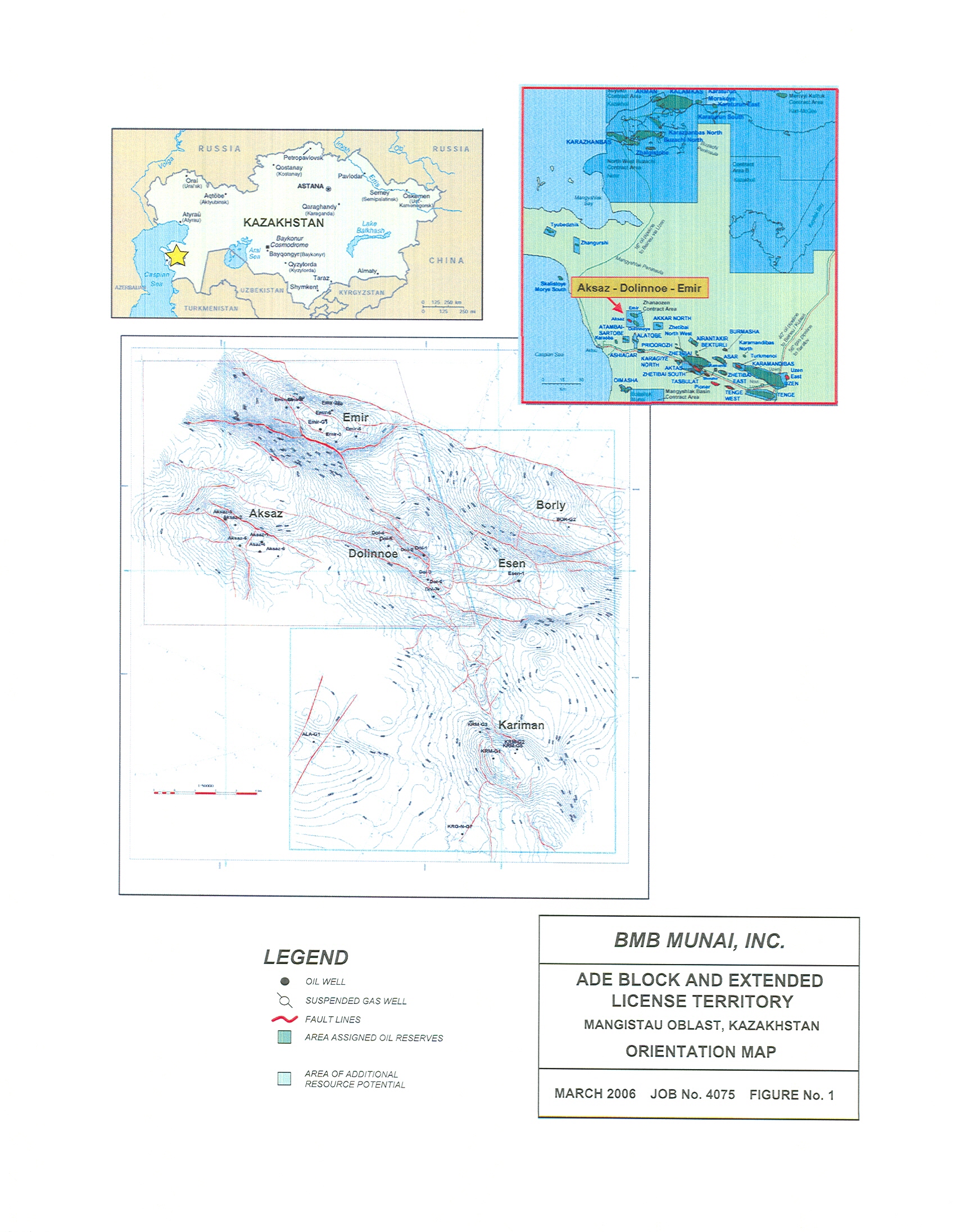 12
12
We currently own a 100% interest in a license to use subsurface mineral
resources and a hydrocarbon exploration contract issued by the ROK in 1999 and
2000, respectively (collectively referred to herein as the "license" or the
"contract"). The original contract granted its holder the right to engage in
exploration and development activities in an area of approximately 200 square
kilometers referred to as the ADE Block. The ADE Block is located onshore in
Kazakhstan in the Mangistau Oblast, approximately 50 kilometers from the
Kazakhstan city of Aktau, a seaport on the Caspian Sea. The ADE Block is
comprised of three fields, the Aksaz, Dolinnoe and Emir fields. When initially
granted, the exploration and development stage of the contract had a five year
term. The time for exploration and development has since been extended to July
9, 2007, and we have the right to seek a two-year extension of our exploration
contract. To move from the exploration and development to the commercial
production, we must make application to the ROK before July 9, 2007; or we may
apply to extend our exploration contract an additional two years with the
application for a commercial production license to be made prior to the
expiration of the two-year extension.
During the fiscal year ended March 31, 2005, our exploration contract
was expanded to include an additional 260 kilometers of land adjacent to the ADE
Block, which we refer to as the "Extended Territory." The Extended Territory is
governed by the terms of the original contract.
Under the terms of our contract we have the right to gather and sell
all oil and natural gas we produce in test production until the expiration of
our exploration contract, or its extension, with the revenue from such sales
belonging to BMB. We intend to continue to apply for export quotas in the future
because we realize significantly higher prices in the world market than the
domestic market price for Kazakhstan. If we are not granted future export
quotas, we will continue to sell our oil in the Kazakhstan domestic market.
To maintain our contract during the exploration and development stage
we are required to meet minimum annual capital expenditures in the exploration
and development of the ADE Block and the Extended Territory. The following table
shows the minimum capital expenditures we are required to make during the 2006
calendar year and for the period from January 1, 2007 through July 9, 2007.
Year Minimum Capital Expenditure
2006 $6,000,000
2007 $4,500,000
If we apply for the two-year extension of our exploration contract, we
will be required to make additional minimum capital expenditures during the
extension period to maintain our rights under the exploration contract.
Under the terms of the contract, we must apply to the ROK for
commercial production rights prior to the expiration of our contract, or its
extension. The terms of our commercial production rights and royalty rates will
be negotiated at the time we move to commercial production. During exploration
and development stage, we have the right to produce and sell oil and natural gas
at a royalty rate of 2%. When we move to commercial production, the negotiated
13
royalty rates vary depending on reserves and production rates. Royalty rates are
established by the taxing authorities of the ROK and are based on production
rates; the rate increases on a sliding scale. Current royalty rates range for 2%
to 6%. Commercial production rights may also require that up to 20% of our oil
production be sold to the Kazakhstan domestic market at considerably lower
prices than we receive in the world export markets, as discussed above.
Under our contract, we have the exclusive right to apply for and
negotiate a commercial production contract. The government is required to
negotiate the terms of these rights in good faith in accordance with the Law of
Petroleum of Kazakhstan. As long as we establish commercially producible
reserves and have fulfilled our obligations during exploration and development,
the government is required to grant us production rights. We have not yet
applied for commercial production rights because we enjoy certain economic
advantages during exploration and development as discussed herein.
During the fiscal year ended March 31, 2006 we drilled one new well in
the Aksaz field. This well was successfully completed and is in testing, test
production or additional workover.
Title to Properties
We hold an exploration contract from the Republic of Kazakhstan that
grants us the right for exploration and test production of hydrocarbons on the
ADE Block and the Extended Territory. Our rights to these properties will
terminate in July 2007 unless we are able to negotiate an extension of our
current exploration contract or we are granted a commercial production contract.
Marketing
Currently all of our test production is being sold to one client. We
anticipate that once we move to commercial production we will market our
production to third parties consistent with industry practices.
There are a variety of factors which affect the market for oil and
natural gas, including the extent of domestic production and imports of oil and
natural gas, the availability, proximity and capacity of natural gas pipelines
and other transportation facilities, demand for oil and natural gas, the
marketing of competitive fuels and the effects of state and federal regulations
on oil and natural gas productions and sales.
Sales to Major Customers
We are now exporting all of our test production for sell in the world
market. Currently, all of our production is being sold to one client, Euro-Asian
Oil AG. Our crude oil is transported via the Aktau sea port to world markets.
Sales prices at the port locations are based on the average quoted Brent crude
oil price from Platt's Crude Oil Marketwire for the three days following the
bill of lading date less discount of $14.15 for transportation expenses, freight
charges and other expenses.
14
In the exploration, development and production business, production is
normally sold to relatively few customers. Our customers are concentrated in the
oil and gas industry, and revenue can be materially affected by current economic
conditions and the price of certain commodities such as natural gas and crude
oil the cost of which is passed through to the customer. However, based on the
current demand for natural gas and crude oil and the fact that alternate
purchasers are readily available, we believe that the loss of Euro-Asian Oil AG
would not have a long-term material adverse effect on our operations.
Competition
Hydrocarbons exploration is highly competitive. Competition in
Kazakhstan and Central Asia includes other junior hydrocarbons exploration
companies, mid-size producers and major exploration and production companies. We
compete for additional exploration and production properties with these
companies who in many cases may have greater financial resources and larger
technical staff than we do.
We believe we have an advantage over our competitors: our executive
management and our board of directors have domestic and international experience
and have been working in Kazakhstan and Russia for up to 30 years. They have
developed relationships with the Kazakhstan government, its departments and
ministries at many levels. We also employ experienced national and foreign
specialists at senior levels in our operating subsidiary, Emir Oil, LLP.
We face significant competition for capital from other exploration and
production companies and industry sectors. At times, other industry sectors may
be more in favor with investors, limiting our ability to obtain necessary
capital.
Government Regulation
Our operations are subject to various levels of government controls and
regulations at various levels in both the United States and in Kazakhstan. We
attempt to comply with all legal requirements in the conduct of our operations
and employ business practices that we consider to be prudent under the
circumstances in which we operate. It is not possible for us to separately
calculate the costs of compliance with environmental and other governmental
regulations as such costs are an integral part of our operations.
In Kazakhstan, legislation affecting the oil and gas industry is under
constant review for amendment or expansion. Pursuant to such legislation,
various governmental departments and agencies have issued extensive rules and
regulations which affect the oil and gas industry, some of which carry
substantial penalties for failure to comply. These laws and regulations can have
a significant impact on the industry by increasing the cost of doing business
and, consequentially, can adversely affect our profitability. Inasmuch as new
legislation affecting the industry is commonplace and existing laws and
regulations are frequently amended or reinterpreted, we are unable to predict
the future cost or impact of complying with such laws and regulations.
15
Risks Relating to the Oil and Natural Gas Industry
A substantial or extended decline in oil and natural gas prices may
adversely affect our business, financial condition, cash flow, liquidity or
results of operations and ability to meet our capital expenditure obligations
and financial commitments and implement our business strategy.
Our business is heavily dependent upon the prices of, and demand for,
oil and natural gas production and the level of such production will be subject
to wide fluctuations and depend on numerous factors beyond our control,
including the following:
o the domestic and foreign supply of oil and natural gas;
o the price and quantity of imports of crude oil and natural gas:
o political conditions and events in other oil-producing and natural
gas-producing countries, including embargoes, continued hostilities
in the Middle East, Iran, Nigeria and other sustained military
campaigns, and acts of terrorism or sabotage;
o the actions of the Organization of Petroleum Exporting Countries, or
OPEC;
o domestic government regulation, legislation and policies;
o the level of global oil and natural gas inventories;
o weather conditions;
o technological advances affecting energy consumption;
o the price availability of alternative fuels; and
o overall economic conditions.
Any continued and extended decline in the price of crude oil or natural
gas will adversely affect:
o our revenues, profitability and cash flow from operations;
o the value of our proved oil and natural gas reserves;
o the economic viability of certain of our drilling prospects;
o our borrowing capacity; and
o our ability to obtain additional capital.
In December 2005 we were granted our first export quota from the
Ministry of Energy and Mineral Resources of the Republic of Kazakhstan ("MEMR")
which allowed us to begin exporting oil for sale in the world market in January
2006. We have also been granted export quotas in March, April, May and June
2006. Prior to January 2006, we were limited to selling our test production to
the domestic market in Kazakhstan. The price of oil in the domestic market in
Kazakhstan is materially lower than the price in the world market. There is no
guarantee that the Republic of Kazakhstan will continue to grant us export
quotas in the future. In the event we are not granted an export quota in the
future, we will be limited to selling our production to the domestic Kazakhstan
market, which likely will result in us realizing lower revenue per barrel of oil
sold than we would realize in the world market.
We have not entered into crude oil and natural gas price hedging
arrangements on any of our anticipated sales. However, we may in the future
enter into such arrangements in order to reduce our exposure to price risks.
Such arrangements may limit our ability to benefit from increases in oil and
natural gas prices.
16
Reserve estimates depend on many assumptions that may turn out to be
inaccurate. Any material inaccuracies in these reserve estimates or underlying
assumptions will materially affect the quantities and present value of our
reserves.
The process of estimating oil and natural gas reserves is complex. It
requires interpretations of available technical data and many assumptions,
including assumptions relating to economic factors. Any significant inaccuracies
in these interpretations or assumptions could materially affect the estimated
quantities and present value of reserves shown in this prospectus.
In order to prepare our estimates, we must project production rates and
timing of development expenditures. We must also analyze available geological,
geophysical, production and engineering data. The extent, quality and
reliability of this data can vary. The process also requires economic
assumptions about matters such as oil and natural gas prices, drilling and
operating expenses, capital expenditures, taxes and availability of funds.
Therefore, estimates of oil and natural gas reserves are inherently imprecise.
Actual future production, oil and natural gas prices, revenues, taxes,
development expenditures, operating expenses and quantities of recoverable oil
and natural gas reserves most likely will vary from our estimates. Any
significant variance could materially affect the estimated quantities and
present value of reserves shown in this prospectus. In addition, we may adjust
estimates of proved reserves to reflect production history, results of
exploration and development, prevailing oil and natural gas prices and other
factors, many of which are beyond our control.
You should not assume that the present value of future net revenues
from our proved reserves referred to in this prospectus is the current market
value of our estimated oil and natural gas reserves. In accordance with SEC
requirements, we generally base the estimated discounted future net cash flows
from our proved reserves on prices and costs on the date of the estimate. Actual
future prices and costs may differ materially from those used in the present
value estimate. If future values decline or costs increase, it could have a
negative impact on our ability to finance operations; individual properties
could cease being commercially viable; affecting our decision to continue
operations on producing properties or to attempt to develop properties. All of
these factors would have a negative impact on earnings and net income, and most
likely the trading price of our securities.
A substantial percentage of our proven properties are undeveloped;
therefore the risk associated with our success is greater than would be the case
if the majority of our properties were categorized as "proved developed
producing."
Because a substantial percentage of our proven properties are "proved
undeveloped" (approximately 20%), or "proved developed non-producing"
(approximately 68%), we will require significant additional capital to develop
such properties before they may become productive. Further, because of the
inherent uncertainties associated with drilling for oil and gas, some of these
properties may never be developed to the extent that they result in positive
17
cash flow. Even if we are successful in our development efforts, it could take
several years for a significant portion of our undeveloped properties to be
converted to positive cash flow.
We will be unable to produce up to 94% of our proved reserves if we are
not able to extend our current contract or obtain a new contract from the
Republic of Kazakhstan, which would likely require us to terminate our
operations.
Under our current contract for exploration of hydrocarbons on the
Aksaz, Dolinnoe and Emir fields, we have the right to produce oil and gas only
until July 2007, yet 94% of our proved reserves are scheduled to be produced
after July 2007. We have the ability to extend our current exploration contract
to July 2009. We also have the exclusive right to negotiate a commercial
production contract as per the terms of our exploration contract. If, however,
we are unable to obtain a commercial production contract prior to the expiration
of our exploration contract, we will lose our right to produce the reserves on
our current properties. If we are unable to produce those reserves, we will be
unable to realize revenues and earnings and to fund operations and we would most
likely be unable to continue as a going concern.
Prospects that we decide to drill may not yield oil or natural gas in
commercially viable quantities or quantities sufficient to meet our targeted
rate of return.
A "prospect" is a property which, based on available seismic and
geological data, we believe shows potential oil or natural gas. Our prospects
are in various stages of evaluation and interpretation. There is no way to
predict in advance of drilling and completion costs whether a prospect will be
economically viable. Even with seismic data and other technologies and the study
of producing fields in the same area, we cannot know conclusively prior to
drilling whether oil or natural gas will be present or, if present, will be
present in commercial quantities. The analysis that we perform using data from
other wells, more fully explored prospects and /or producing fields may not be
useful in predicting the characteristics and potential reserves associated with
our drilling prospects. If we drill additional unsuccessful wells, our drilling
success rate may decline and we may not achieve our targeted rate of return.
We may incur substantial losses and be subject to substantial liability
claims as a result of our oil and natural gas operations.
We are not insured against all risks. Losses and liabilities arising
from uninsured and underinsured events could materially and adversely affect our
business, financial condition or results of operations. Our oil and natural gas
exploration and production activities are subject to all of the operating risks
associated with drilling for and producing oil and natural gas, including the
possibility of:
o environmental hazards, such as uncontrollable flows of oil, natural
gas, brine, well fluids, toxic gas or other pollution into the
environment, including groundwater and shoreline contamination;
o abnormally pressured formations;
o mechanical difficulties, such as stuck oil field drilling and
service tools and casing collapse;
18
o fires and explosions;
o personal injuries and death; and
o natural disasters.
Any of these risks could adversely affect our ability to conduct
operations or result in substantial losses to our company. We may elect not to
obtain insurance if we believe that the cost of available insurance is excessive
relative to the risks presented. In addition, pollution and environmental risks
generally are not fully insurable. If a significant accident or other event
occurs that is not fully covered by insurance, it could adversely affect us.
We are subject to complex laws that can affect the cost, manner or
feasibility of doing business.
Exploration, development, production and sale of oil and natural gas
are subject to extensive federal, state, local and international regulation. We
may be required to make large expenditures to comply with governmental
regulations. Matters subject to regulation include:
o discharge permits for drilling operations;
o drilling bonds;
o reports concerning operations;
o the spacing of wells;
o unitization and pooling of properties; and
o taxation.
Under these laws, we could be liable for personal injuries, property
damage and other damages. Failure to comply with these laws may also result in
the suspension or termination of our operations and subject us to
administrative, civil and criminal penalties. Moreover, these laws could change
in ways that substantially increase our costs. Any such liabilities, penalties,
suspensions, terminations or regulatory changes could materially adversely
affect our financial condition and results of operations.
Our operations may incur substantial liabilities to comply with the
environmental laws and regulations.
Our oil and natural gas operations are subject to stringent federal,
state and local laws and regulations relating to the release or disposal of
materials into the environment or otherwise relating to environmental
protection. These laws and regulations may require the acquisition of a permit
before drilling commences, restrict the types, quantities and concentration of
substances that can be released into the environment in connection with drilling
and production activities, limit or prohibit drilling activities on certain
lands lying within wilderness, wetlands and other protected areas, and impose
substantial liabilities for pollution resulting from our operations. Failure to
comply with these laws and regulations may result in the assessment of
administrative, civil and criminal penalties, imposition of investigatory or
remedial obligations or even injunctive relief. Changes in environmental laws
and regulations occur frequently; any changes that result in more stringent or
costly waste handling, storage, transport, disposal or cleanup requirements
could require us to make significant expenditures to maintain compliance, and
may otherwise have a material adverse effect on our results of operations,
19
competitive position or financial condition as well as on the industry in
general. Under these environmental laws and regulations, we could be held
strictly liable for the removal or remediation of previously released materials
or property contamination regardless of whether we were responsible for the
release or whether our operations were standard in the industry at the time they
were performed.
Unless we replace our oil and natural gas reserves, our reserves and
future production will decline, which would adversely affect our cash flows and
income.
Unless we conduct successful development, exploration and exploitation
activities or acquire properties containing proved reserves, our proved reserves
will decline as those reserves are produced. Producing oil and natural gas
reservoirs generally are characterized by declining production rates that vary
depending upon reservoir characteristics and other factors. Our future oil and
natural gas reserves and production, and, therefore our cash flow and income,
are highly dependent on our success in efficiently developing and exploiting our
current reserves and economically finding or acquiring additional recoverable
reserves. If we are unable to develop, exploit, find or acquire additional
reserves to replace our current and future production, our cash flow and income
will decline as production declines, until our existing properties would be
incapable of sustaining commercial production.
If we do not satisfy our commitments to the government of Kazakhstan
while we are engaged in exploration and development activities we could lose our
rights to the ADE Block and the Extended Territory.
We have committed to the government of Kazakhstan to make various
capital investments and to develop the ADE Block and the Extended Territory in
accordance with specific requirements during exploration and development.
Additionally, to undertake commercial production, we will need to apply for and
be granted commercial production rights. The requirements of our current license
may be inconsistent with the terms of any new licenses we are issued.
Additionally, we may not be able to satisfy all commitments in the future. If we
fail to satisfy these commitments our contract may be cancelled. The
cancellation of our contract could have a material adverse effect on our
business, results of operations and financial condition. Although we would seek
waivers of any breaches or seek to renegotiate the terms of our commitments, we
cannot assure you that we would be successful in doing so.
Our activities, and correspondingly, our ability to generate revenue to
support operations, could be adversely affected because of inadequate
infrastructure in the region where our properties are located.
Our exploration and development activities could suffer due to
inadequate infrastructure in the region. We are working to improve the
infrastructure on our properties. Any problem or adverse change affecting our
operational infrastructure, or infrastructure provided by third parties, could
have a material adverse effect on our financial condition and results of
operations. Similarly, if we are unsuccessful in developing the infrastructure
on our properties it could have a material adverse effect on our financial
conditions and results of operations.
20
The unavailability or high cost of drilling rigs, equipment, supplies,
personnel and oil field services could adversely affect our ability to execute
on a timely basis our exploration and development plans within our budget.
Shortages or the high cost of drilling rigs, equipment, supplies or
personnel could delay or adversely affect our development and exploration
operations. As the price of oil and natural gas increases, the demand for
production equipment and personnel will likely also increase, potentially
resulting, at least in the near-term, in shortages of equipment and personnel.
In addition, larger producers may be able to secure access to such equipment by
offering drilling companies more lucrative terms. If we are unable to acquire
access to such resources, or can obtain access only at higher prices, not only
would this potentially delay our ability to convert our reserves into cash flow,
but this could also significantly increase the cost of producing those reserves,
thereby having a negative impact on anticipated net income.
The unavailability or high price of transportation systems could
adversely affect our ability to deliver our production to oil and natural gas
markets on terms that would allow us to operate profitably, or at all.
Because of the location of our properties, the crude oil we produce
must be transported by truck or by rail. In the future it will likely also be
transported by pipelines. These railways and pipelines are operated by
state-owned entities or other third parties, and there can be no assurance that
these transportation systems will always be functioning and available, or that
the transportation costs will remain at acceptable levels. In addition, any
increase in the cost of transportation or reduction in its availability to us
could have a material adverse effect on our results of operations. There is no
assurance that we will be able to procure sufficient transportation capacity on
economical terms, if at all.
Competition in the oil and natural gas industry is intense, which may
adversely affect our ability to compete.
We operate in a highly competitive environment for acquiring
properties, marketing oil and natural gas and securing trained personnel. Many
of our competitors possess and employ financial, technical and personnel
resources which are substantially greater than ours, this can be particularly
important in the areas in which we operate. Those companies may be able both to
pay more for productive oil and natural gas properties and exploratory prospects
and to evaluate, bid for and purchase a greater number of properties and
prospects than our financial or personnel resources permit. Our ability to
acquire additional prospects and to find and develop reserves in the future will
depend on our ability to evaluate and select suitable properties and to
consummate transactions in a highly competitive environment. There is
substantial competition for capital available for investment in the oil and
natural gas industry. We may not be able to compete successfully in the future
in acquiring prospective reserves, developing reserves, marketing hydrocarbons,
attracting and retaining quality personnel or raising additional capital.
21
Risks Relating to Our Business
The loss of senior management and key personnel could adversely affect
us.
Our success is dependent on the performance of our senior management
and key technical personnel each of whom has extensive experience in the oil and
gas industry. The loss of such individuals, in particular, Boris Cherdabayev,
our CEO and Chairman of our Board of Directors, or Toleush Tolmakov, the General
Director of Emir Oil, our wholly-owned subsidiary, could have an adverse effect
on our business. We do not have employment agreements in place with our senior
management or key employees. We do not currently carry key man insurance for any
of our senior management or key employees, nor do we anticipate obtaining key
man insurance in the foreseeable future.
If you purchase shares of our stock, your investment will be subject to
the same risks inherent in international operations, including, but not limited
to, adverse governmental actions, political risks, and expropriation of assets,
loss of revenues and the risk of civil unrest or war.
We believe that the present policies of the government of the Republic
of Kazakhstan are favorable to foreign investment and to exploration and
production and we are not aware of any impending changes. While there is a
certain amount of bureaucratic "red tape" we have significant experience working
in Kazakhstan, and good relationships with government agencies at many levels.
We, however, remain subject to all the risks inherent in international
operations, including adverse governmental actions, uncertain legal and
political systems, and expropriation of assets, loss of revenues and the risk of
civil unrest or war. Our primary oil and gas properties are located in
Kazakhstan, which until 1990 was part of the Soviet Union. Kazakhstan retains
many of the laws and customs of the former Soviet Union, but has and is
continuing to develop its own legal, regulatory and financial systems. As the
political and regulatory environment changes, we may face uncertainty about the
interpretation of our agreements; in the event of dispute, we may have limited
recourse within the legal and political system.
If we are successful in establishing commercially producible reserves
on our properties, an application will be made for a commercial production
contract. We have the exclusive right to negotiate this contract for the ADE
Block and Extended Territory, and the government is required to conduct these
negotiations under the "Law of Petroleum." Such contracts are customarily
awarded upon determination that the field is capable of commercial rates of
production and that we have complied with the other terms of our license and
exploration contract. The terms of the commercial production contract will
establish the royalty and other payments due to the government in connection
with commercial production. At the time the commercial production contract is
issued, we will be required to begin repaying the government its historical
investment costs of exploration and development of the ADE Block and the
Extended Territory. Our obligation associated with the ADE Block is
approximately $6 million. Our obligation associated with the Extended Territory
22
has not yet been determined and is currently being negotiated. If satisfactory
terms for commercial production rights cannot be negotiated, it could have a
material adverse effect on our financial position.
Employees
As of May 15, 2006 we had 199 full-time employees. We believe that our
relationships with our employees are good. None of our employees are covered by
a collective bargaining agreement. From time to time we utilize the services of
independent consultants and contractors to perform various professional
services. Field and on-site production operation services, such as pumping,
maintenance, dispatching, inspection and testing are generally provided by
independent contractors.
Executive Offices
Our principal executive and corporate offices are located in an office
building located at 202 Dostyk Avenue, in Almaty, Kakzakhstan. We lease this
space and believe it is sufficient to meet our needs for the foreseeable future.
We also maintain administrative office in Salt Lake City, Utah. The
address is 324 South 400 West, Suit 225, Salt Lake City, Utah 84101, USA.
Reports to Security holders
We file Annual Reports on Form 10-KSB, Quarterly Reports on Form
10-QSB, Current Reports on Form 8-K and other items with the Securities and
Exchange Commission (SEC). We provide free access to all of these SEC filings,
as soon as reasonably practicable after filing, on our Internet web site located
at www.bmbmunai.com. In addition, the public may read and copy any documents we
file with the SEC at the SEC's Public Reference Room at 100 F Street N.E.,
Washington, DC 20549. The public may obtain information on the operation of the
Public Reference Room by calling the SEC at 1-800-SEC-0330. The SEC maintains
its Internet site www.sec.gov, which contains reports, proxy and information
statements and other information regarding issuers like BMB Munai.
Item 3. Legal Proceedings.
In December 2003, a complaint was filed in the 15th Judicial Court in
and for Palm Beach County, Florida, naming, among others, us, Georges Benarroch
and Alexandre Agaian, current or former BMB directors, as defendants. The
plaintiffs, Brian Savage, Thomas Sinclair and Sokol Holdings, Inc., allege
claims of breach of contract, unjust enrichment, breach of fiduciary duty,
conversion and violation of a Florida trade secret statute in connection with a
business plan for the development Aksaz, Dolinnoe and Emir oil and gas fields
owned by Emir Oil, LLP. The parties mutually agreed to dismiss this lawsuit
without prejudice.
In April 2005, Sokol Holdings, Inc., also filed a complaint in United
States District Court, Southern District of New York alleging that BMB Munai,
Inc., Boris Cherdabayev, Alexandre Agaian, Bakhytbek Baiseitov, Mirgali Kunayev
and Georges Benarroch wrongfully induced Toleush Tolmakov to breach a contract
23
under which Mr. Tolmakov had agreed to sell to Sokol 70% of his 90% interest in
Emir Oil LLP.
In October 2005, Sokol Holdings amended its complaint in the U.S.
District Court in New York to add Brian Savage and Thomas Sinclair as plaintiffs
and to add Credifinance Capital, Inc., and Credifinance Securities, Ltd.,
(collectively "Credifinance") as defendants in the matter. The amended complaint
alleges tortious interference with contract, specific performance, breach of
contract, unjust enrichment, breach of fiduciary duty by Georges Benarroch,
Alexandre Agaian and Credifinance, conversion, breach of fiduciary duty by Boris
Cherdabayev, Mirgali Kunayev and Bakhytbek Baiseitov, misappropriation of trade
secrets, tortuous interference with fiduciary duty by Mr. Agaian, Mr. Benarroch
and Credifinance and aiding and abetting breach of fiduciary duty by Mr.
Benarroch, Mr. Agaian and Credifinance in connection with a business plan for
the development of the Aksaz, Dolinnoe and Emir oil and gas fields owned by Emir
Oil, LLP. The plaintiffs have not named Toleush Tolmakov as defendant in the
action nor have the plaintiffs ever brought claims against Mr. Tolmakov to
establish the existence or breach of any legally binding agreement between the
plaintiffs and Mr. Tolmakov. The plaintiffs seek damages in an amount to be
determined at trial, punitive damages, specific performance and such other
relief as the Court finds just and reasonable.
We have retained the law firm of Bracewell & Giuliani LLP in New York,
New York to represent us in the lawsuit. We moved for dismissal of the amended
complaint or for a stay pending arbitration in Kazakhstan. That motion was
denied, without prejudice to renewing it, to enable defendants to produce
documents to plaintiffs relating to the issues raised in the motion. Following
completion of document production, the motion has been renewed.
In the opinion of management, the resolution of this lawsuit will not
have a material adverse effect on our financial condition, results of operations
or cash flows.
In November 2005 we learned that the Company had been added as a
defendant in a lawsuit filed by Bank CenterCredit against Optima Systems, LLP,
KazOvoshProm Company, LLP, Intexi LLP and a number of other parties. The lawsuit
was filed in the Special Interregional Economic Court of Almaty, Kazakhstan.
Under Kazakhstani law, it is illegal for a party to purchase stock of a bank
with borrowed funds. The lawsuit alleges that Optima Systems KazOvoshProm
Company and Intexi illegally shares of Bank CenterCredit in open market
transactions in the Kazakhstan Stock Market from a number of parties, including
BMB Munai, with borrowed funds.
On June 13, 2006 we learned that the Special Interregional Economic
Court of Almaty, Kazakhstan ruled that we had no liability in this lawsuit and
has dismissed us as a defendant in the lawsuit.
Other than the foregoing, to the knowledge of management, there is no
other material litigation or governmental agency proceeding pending or
threatened against the Company or our management.
24
Item 4. Submission of Matters to a Vote of Security Holders
No matters were submitted to a vote of security holders during the
quarter ended March 31, 2006. Subsequent to the quarter end on April 18, 2006,
we held a special meeting of our stockholder. The total number of shares
entitled to vote at the meeting was 42,198,690. The number of shares represented
at the special meeting of stockholders, present or by proxy was 23,320,834. At
the meeting the shareholders were asked to vote on the following matter:
1) To ratify the adoption of a corporate policy governing future
acquisitions of additional oil and gas licenses in exchange for
shares of Company common stock; and
2) To amend our Articles of Incorporation to increase the authorized
capital stock of the Company to 500,000,000 common shares.
23,320,584 shares voted to ratify the acquisitions policy and due
diligence protocol and 250 shares voted against ratification of the acquisitions
policy and due diligence protocol. No shares abstained.
22,968,520 shares voted to approve an amendment to our Articles of
Incorporation to increase our authorized common stock to 500,000,000 and 352,313
shares voted against the amendment to our Articles of Incorporation and one
share abstained from voting. On June 21, 2006 we filed an amendment to our
Articles of Incorporation increasing our authorized common stock to 500,000,000
shares.
No other items were submitted to a vote of our shareholders at the
meeting.
PART II
Item 5. Market for Common Equity, Related Stockholder Matters and Small Business
Issuer Purchases of Equity Securities
Our shares are currently traded on the Over-the-Counter Bulletin Board
("OTCBB") under the symbol BMBM. As of June 22, 2006, we had approximately 620
shareholders of record holding 43,740,657 shares of our common stock. The number
of record holders was determined from the records of our transfer agent and does
not include beneficial owners of common stock whose shares are held in the names
of various security brokers, dealers, and registered clearing agencies. We
believe that, in addition, there are beneficial owners of our common stock whose
shares are held in street name and, consequently, we are unable to determine the
actual number of beneficial holders of our common stock.
Of the issued and outstanding common stock, approximately 9,553,445 are
free trading, the balance are "restricted securities" as that term is defined in
Rule 144 promulgated by the Securities and Exchange Commission.
The published high and low bid quotations from April 1, 2004 through
March 31, 2006, were furnished to us by Pink Sheets, LLC, are included in the
chart below. These quotations represent prices between dealers and do not
include retail markup, markdown or commissions and may not represent actual
transactions.
25
High Low
Fiscal year ending March 31, 2006
First Quarter $5.30 $4.01
Second Quarter $8.15 $4.65
Third Quarter $7.50 $6.00
Fourth Quarter $9.70 $6.70
Fiscal year ending March 31, 2005
First Quarter $5.75 $3.80
Second Quarter 7.65 3.00
Third Quarter 7.05 3.00
Fourth Quarter 5.40 4.60
Cash Dividends
During the fiscal year ended March 31, 2006, the Company did not pay,
nor declare, any dividends. The Company's ability to pay dividends is subject to
limitations imposed by Nevada law. Under Nevada law, dividends may be paid to
the extent that the corporation's assets exceed it liabilities and it is able to
pay its debts as they become due in the usual course of business. The Board of
Directors does not, however, anticipate paying any dividends in the foreseeable
future; it intends to retain the earnings that could be distributed, if any, for
the operations, expansion and development of its business.
Securities for Issuance Under Equity Compensation Plans
As of June 22, 2006, shares of our common stock were subject to
issuance upon the exercise of outstanding options or warrants as set forth
below.
- ------------------------- --------------------------- --------------------------- ------------------------------------
Plan category Number of securities Weighted-average Number of securities
to be issued upon exercise price of remaining available for future
exercise of outstanding issuance under equity
outstanding options, options, warrants compensation plans
warrants and rights and rights (excluding securities reflected in
columns (a))
(a) (b) (c)
- ------------------------- --------------------------- --------------------------- ------------------------------------
Equity compensation
plans approved by
security holders 1,173,583 $5.32 2,805,000
- ------------------------- --------------------------- --------------------------- ------------------------------------
26
Equity compensation
plans not approved by
security holders 142,857 $3.50 -0-
- ------------------------- --------------------------- --------------------------- ------------------------------------
Total 1,356,440 $5.12 2,805,000
- ------------------------- --------------------------- --------------------------- ------------------------------------
On November 19, 2003 we granted an option to Credifinance Securities
Limited for services rendered by Credifinance as our agent in connection with
private placements made by us in November 2003. Georges Benarroch, a Company
director is also the CEO of Credifinance and may be deemed to be a related
party. The option grants Credifinance the right to purchase up to 142,857 shares
of our common stock at an exercise price of $3.50 per share. The option expires
on November 26, 2008. The option provides for adjustments to the number of
shares and/or the price per share to protect the holder against dilution and in
the event of mergers, reorganizations and similar events. The option also
requires that in the event we determine to make a registered public offering
during the term of the option, we shall use our best efforts to include the
common shares underlying the options in the registration statement.
In October 2004 we agreed to grant stock options under our 2004 Stock
Incentive Plan to Gary Lerner, our former corporate secretary, to purchase
60,000 shares of our common stock. The options have an exercise price of $4.00
per share and expire in October 2009. In April 2006, Mr. Lerner exercised
options to purchase 7,200 shares of our common stock.
On July 18, 2005 our Board of Directors approved stock option grants
and restricted stock awards under our 2004 Stock Incentive Plan subject to
acceptance of those grants by the parties to whom they were granted. The total
number of options and restricted stock grants was 820,783 and 469,217,
respectively. The options are exercisable at a price of $4.75, the closing price
of the Company's common stock on the OTCBB on July 18, 2005. The options will
expire five years from the grant date. Of the restricted stock grants, 389,217
vested immediately. The remaining shares will vest to the three individuals to
whom they were granted in equal amounts upon the one year, two year and three
year anniversaries of their employment with the Company. Among the parties
receiving stock options and restricted stock grants were the following executive
officers and directors:
Name Positions with Company Options Granted Restricted Stock Granted
- ---------------------------- ---------------------- --------------- ------------------------
Boris Cherdabayev CEO and Director 410,256 189,744
Anuar Kulmagambetov Former CFO 232,632 107,368
Georges Benarroch Director 68,421 31,579
Valery Tolkachev Director 68,421 31,579
In January 2006, we entered into a separation agreement with our former
CFO, Anuar Kulmagambetov, to issue Mr. Kulmagambetov 50,000 restricted common
shares and an option to purchase up to 100,000 shares of restricted common stock
of the Company at $7.40 per share expiring five years from the date of grant.
27
On June 20, 2006 our Board of Directors approved stock option grants
and restricted stock awards to our officers and directors and certain employees
and consultants of the Company under our 2004 Stock Incentive Plan. The total
number of options and restricted stock grants was 200,000 and 495,000
respectively. The options are exercisable at a price of $7.00 per share, which
was the closing price of our common stock on the OTCBB on June 20, 2006. The
restricted stock grants were also valued at $7.00 per share. The options will
expire three years from the grant date. All of the options and restricted stock
grants vested immediately upon grant. Among the parties receiving restricted
stock grants were the following executive officers and directors:
Name Positions with Company Options Granted Restricted Stock Granted
- ---------------------------- ---------------------- --------------- ------------------------
Boris Cherdabayev CEO and Director 150,000 80,000
Askar Tashtitov President - 40,000
Sanat Kasymov CFO - 40,000
Gamal Kulumbetov COO - 40,000
Georges Benarroch Director - 10,000
Troy Nilson Director - 10,000
Stephen Smoot Director - 10,000
Valery Tolkachev Director 50,000 40,000
Recent Sales of Unregistered Securities.
During and subsequent to the quarter ended March 31, 2006 the following
equity securities, which were not registered under the Securities Act of 1933,
were issued.
During January 2006, we entered into a separation agreement with our
former CFO, Anuar Kulmagambetov, to issue Mr. Kulmagambetov 50,000 restricted
common shares of the Company; and an option to purchase up to 100,000 shares of
the Company's restricted common stock at $7.40 per share expiring five years
from the date of grant. Mr. Kulmagambetov's resignation was not the result of
any disagreement with the Company on any matter relating to our operations,
policies or practices.
Between January and March 22, 2006, Credifinance Capital Corp.,
exercised warrants to purchase 148,980 common shares for $4.00 per share for an
aggregate purchase price of $595,560. The shares were issued without
registration pursuant to Regulation S of the Securities Act Rules.
In April 2006, Gary Lerner, our former corporate secretary, exercised
options to purchase 7,200 shares of our common stock at a price of $4.00 per
share. The shares were issued without registration under the Securities Act of
1933 in reliance upon Section 4(2) of the Securities Act of 1933.
On April 10, 2006, Credifinance Capital Corp., a related company
through a common director, exercised warrants granted in April 2005 to purchase
50,100 shares of our restricted common stock for $250,500. The shares were
issued without registration pursuant to Regulation S of the Securities Act
Rules.
28
On May 12, 2006, Aton International, Ltd., exercised warrants granted
in December 2005 to purchase 916,667 restricted common shares for $6.00 per
shares for an aggregate purchase price of $5,500,002. The shares were issued
without registration pursuant to Regulation S of the rules and regulations
promulgated by the Securities and Exchange Commission under the Securities Act
of 1933.
On June 20, 2006, our Board of Directors approved stock option grants
and restricted stock awards to our officer and directors and certain employees
and consultants of the Company under our 2004 Stock Incentive Plan. The total
number of options and restricted stock grants was 200,000 and 495,000
respectively. The options are exercisable at a price of $7.00 per share, which
was the closing price of our common stock on the OTCBB on June 20, 2006. The
restricted stock grants were also valued at $7.00 per share. The options will
expire three years from the grant date. All of the options and restricted stock
grants vested immediately upon grant. Among the parties receiving restricted
stock grants were the following executive officers and directors:
Name Positions with Company Options Granted Restricted Stock Granted
- ---------------------------- ---------------------- --------------- ------------------------
Boris Cherdabayev CEO and Director 150,000 80,000
Askar Tashtitov President - 40,000
Sanat Kasymov CFO - 40,000
Gamal Kulumbetov COO - 40,000
Georges Benarroch Director - 10,000
Troy Nilson Director - 10,000
Stephen Smoot Director - 10,000
Valery Tolkachev Director 50,000 40,000
Grants were made to a total of 16 people, eleven of whom are non-U.S. persons.
The option and restricted stock grants were made without registration pursuant
to Regulation S of the Securities Act Rules and Section 4(2) under the
Securities Act of 1933.
Repurchases by Small Business Issuer
During the quarter ended March 31, 2006, we did not repurchase any
shares of our Company.
Item 6. Management's Discussion and Analysis of Results of Operations
This discussion summarizes the significant factors affecting our
consolidated operating results, financial condition, liquidity and capital
resources during the fiscal years ended March 31, 2006 and 2005. This discussion
should be read in conjunction with the consolidated financial statements and
footnotes to the consolidated financial statements included in this registration
statement.
Forward-Looking Statements
Certain of the statements contained in herein as well as in all parts
of this document including, but not limited to, those relating to our drilling
plans, future expenses, changes in wells operated and reserves, future growth
and expansion, future exploration, future seismic data, expansion of operations,
generation of new prospects, successful acquisition of a commercial production
29
license, review of outside generated prospects and acquisitions, additional
reserves and reserve increases, management of our asset base, expansion and
improvement of capabilities, integration of new technology into operations,
availability of credit facilities, new prospects and drilling locations, future
capital expenditures and working capital, sufficiency of future working capital,
borrowings and capital resources and liquidity, projected cash flows from
operations, future commodity prices, expectations of timing, the outcome of
legal proceedings, satisfaction of contingencies, the impact of any change in
accounting policies on our financial statements, the number, timing or results
of any wells, the plans for timing, interpretation and results of new or
existing seismic surveys or seismic data, future production or reserves, future
acquisitions of leases, lease options or other land rights, management's
assessment of internal control over financial reporting, financial results,
opportunities, growth, business plans and strategy and other statements that are
not historical facts contained in this report are forward-looking statements.
When used in this document, words like "expect," "project," "estimate,"
"believe," "anticipate," "intend," "budget," "plan," "forecast," "predict,"
"may," "should," "could," "will" and similar expressions are also intended to
identify forward-looking statements. Such statements involve risks and
uncertainties, including, but not limited to, market factors, market prices
(including regional basis differentials) of natural gas and oil, results for
future drilling and marketing activity, future production and costs and other
factors detailed herein and in our other Securities and Exchange Commission
filings. Should one or more of these risks or uncertainties materialize, or
should underlying assumptions prove incorrect, actual outcomes may vary
materially from those indicated. These forward-looking statements speak only as
of their dates and should not be unduly relied upon. We undertake no obligation
to publicly update or revise any forward-looking statement, whether as a result
of new information, future events or otherwise.
Results of Operations
This section includes a discussion of our results of operations for the
fiscal years ended March 31, 2006 and 2005. The following table sets forth
selected operating data for the fiscal years indicated:
For the year ended For the year ended
March 31, 2006 March 31, 2005
----------------------------- -------------------------------
Revenues:
Oil and gas sales $ 5,956,731 $ 973,646
Expenses:
Oil and gas operating(1) 829,514 404,626
Depletion 1,1,67,235 229,406
Depreciation and amortization 133,148 66,451
Accretion 5,602 -
General and administrative 9,724,597 4,060,962
Net Production Data:
Oil (Bbls) 242,522 68,755
Natural gas (Mcf) - -
Barrels of Oil equivalent (BOE) 242,522 68,755
30
Average Sales Price:
Oil (per Bbl) 26.13 15.17
Natural gas (per Mcf) - -
Equivalent price (per BOE) 26.13 15.17
Expenses ($ per BOE):
Oil and gas operating(1) 1.55 3.08
Depreciation, depletion and
amortization(2) 5.12 3.58
- -----------------
(1) Includes direct lifting costs, (labor, repairs and maintenance, materials
and supplies), expensed workover costs and the administrative costs of field
production personnel, insurance and production and ad valorem taxes.
(2) Represents depletion of oil and gas properties only.
Year ended March 31, 2006 compared to the ended March 31, 2005.
Revenue and Production
The following table summarizes production volumes, average sales prices
and operating revenue for our oil and natural gas operations for the year ended
March 31, 2006 and the year ended March 31, 2005.
Fiscal Year ended
March 31, 2006 compared to
the Fiscal Year ended March
31, 2005
------------------------------
For the Fiscal For the Fiscal $ %
Year ended Year ended Increase Increase
March 31, 2006 March 31, 2005 (Decrease) (Decrease)
------------------ -------------------- -------------- ------------
Production volumes:
Natural gas (Mcf) - - - -
Natural gas liquids (Bbls) - - - -
Oil and condensate (Bbls) 242,522 68,755 173,767 253
Barrels of Oil equivalent (BOE) 242,522 68,755 173,767 253
Average Sales Price(1)
Natural gas ($ per Mcf) $ - $ - $ - -
Natural gas liquids ($ per Bbl) $ - $ - $ - -
Oil and condensate ($ per Bbl) $ 26.13 $ 15.17 $ 10.96 72
Barrels of Oil equivalent
($ per BOE) $ 26.13 $ 15.17 $ 10.96 72
Operating Revenue:
Natural gas $ - $ - $ - -
Natural gas liquids $ - $ - $ - -
Oil and condensate $5,956,731 $973,646 $4,983,085 512
Gain on hedging and derivatives(2) $ - $ - $ - -
31
- -----------------
(1) At times, we may produce more barrels than we sell in a given period. The
average sales price is calculated based on the average sales price per
barrel sold, not per barrel produced.
(2) We did not engage in hedging transactions, including derivatives during the
fiscal years ended March 31, 2006 and 2005.
Revenues. We generate revenue under our contract from the sale of oil
recovered during test production. During the year ended March 31, 2006, we
realized revenue from oil sales of $5,956,731 compared to $973,646 during the
year ended March 31, 2005. This increase in revenues is primarily the result of
several factors. During the current fiscal year we performed workover of
re-entered wells and drilled one additional well, which led to increased test
production. We performed works to perforate a productive stratum, which led to a
significant flow of oil at the Dolinnoe-3 well. As a result, during the fiscal
year ended March 31, 2006 the Dolinnoe-3 well accounted for 63% of our total oil
production. Additionally, the price per barrel we received for oil sold
increased 72% during the fiscal year ended March 31, 2006 compared to the fiscal
year ended March 31, 2005. Throughout the 2006 fiscal year domestic market price
increased significantly, consistent with world market prices. Additionally
during fourth fiscal quarter of our 2006 fiscal year we started exporting our
oil to the world markets and realized the world market price for those sales,
which is considerably higher than the domestic market price in Kazakhstan. We
anticipate production will continue to increase in upcoming years. We also hope
to continue to be granted export quotas, which would allow us to realize world
market prices. This would also lead to increased revenue from oil sales compared
to our prior fiscal years because of the increased in price per barrel we would
realize from sales in the world market.
Our revenue is sensitive to changes in prices received for our
products. Our production is sold at the prevailing market price in Kazakhstan
and world markets, which fluctuates in response to many factors that are outside
our control. Imbalances in the supply and demand for oil can have a dramatic
effect on the prices we receive for our production. Political instability, the
economy, weather and other factors outside our control could have an impact on
both supply and demand.
Costs and Operating Expenses
Oil and Gas Operating Expenses. During the fiscal year ended March 31,
2006, we incurred $829,514 in oil and gas operating expenses compared to
$404,626 during the year ended March 31, 2005. Oil and gas operating expenses
increased due to increased production. During the year ended March 31, 2006
production volume increased by 173,767 barrels or 253% compared to the year
ended March 31, 2005. Such increase led to hiring more production and
maintenance personnel and a corresponding payroll increase during the year ended
March 31, 2006 of 34% compared to the year ended March 31, 2005. Increased
production also led to an increase in the royalty paid to the Government of 217%
during the year ended March 31, 2006 compared to the year ended March 31, 2005.
As discussed above, another result of increased production was a $270,336 or
131% increase in transportation expenses during the year ended March 31, 2006
compared to the year ended March 31, 2005.We expect oil and gas operating
expenses to continue to increase in the upcoming fiscal year as revenue
continues to increase.
32
General and Administrative Expenses. General and administrative
expenses during the fiscal year ended March 31, 2006 were $9,724,597 compared to
$4,060,962 during the year ended March 31, 2005. This represents a 139% increase
in general and administrative expenses. This significant increase is
attributable to a 463% increase in payroll and other compensation, a 24%
increase in rent expenses and a 26% increase in professional services fees.
During the year ended March 31, 2006 we granted restricted stock and stock
options to our directors, officers and key employees. Fair value of stock and
stock options was recognized in our consolidated financial statements as
compensation expense. The total amount of compensation expense recognized as a
result of the stock and option grants was $4,800,954. Additionally, during the
year ended March 31, 2006 we hired more administrative personnel to operate our
business, using services of technicians, engineers, accountants and lawyers, as
well as incurring other general corporate expenses. We do not expect general and
administrative expenses to increase at such a significant rate in upcoming
years. We anticipate increases in revenue will outpace the increase in general
and administrative expenses in upcoming quarters.
Loss from Operations. As a result of significantly increasing expenses,
which were only partially offset by revenue from oil sales, during the fiscal
year ended March 31, 2006 we realized a loss from operations of $5,903,365
compared to a loss from operations of $3,787,799 during the fiscal year ended
March 31, 2005. While we realized a 512% increase in revenue during the year
ended March 31, 2006 compared to the comparable period 2005, this increase was
offset by a 105% increase in oil and gas operating expenses, a 409% increase in
depletion expenses and a 139% increase in general and administrative expenses.
This resulted in a 56% increase in loss from operations during the fiscal year
ended March 31, 2006 compared to the fiscal year ended March 31, 2005. Until
such time as expenses exceed revenue from oil and gas sales we will continue to
generate operating losses. In future periods, we believe production rates and
oil prices will be such that we will be able to generate sufficient revenue from
oil sales to offset our expenses. If, however, production levels or oil prices
were to decrease, we may be unable to offset our operating expenses with revenue
from production and could experience additional losses from operations.
Other Income. During the fiscal year ended March 31, 2006 we realized
total other income of $594,075 compared to $501,830 during the fiscal year ended
March 31, 2005. This 18% increase in other income is largely attributable to
$401,563 increase in interest income and $403,151 increase in unrealized gains
on marketable securities. During the year ended March 31, 2006 we received
approximately $55 million for securities sold during a private placement
transaction completed in December 2005. Therefore, at times during the year, we
had funds that were not being used in operations that we invested in deposits
and marketable securities. This income is partially offset by a $513,068
increase in exchange loss resulting from fluctuations of foreign currency rates
against the U.S. Dollar and a $116,125 increase in other expenses. We anticipate
the funds held in deposits and marketable securities will be used to fund our
operations and therefore expect interest income and gains from marketable
securities, both realized and unrealized, to decrease in the next twelve months.
Net Loss. During the fiscal year ended March 31, 2006 we realized a net
loss of $5,344,333 compared to a net loss of $3,286,312 during the fiscal year
ended March 31, 2005. Notwithstanding the significant increase in revenue
resulting from increased oil production during the year ended March 31, 2006 net
33
loss increased significantly. This significant increase in net loss is largely
attributable to 139% increase in general and administrative expenses. During the
year ended March 31, 2006 our general and administrative expenses increased by
$5,663,635 compared to the year ended March 31, 2005. While expenses have risen
significantly during the past year, we do not expect such significant expense
increases in upcoming years. We also anticipate that we will continue to realize
significant increases in revenue as our production levels continue to increase.
Based on these expectations, we anticipate that we will begin to realize net
income in upcoming fiscal years.
Liquidity and Capital Resources
Funding for our activities has historically been provided by funds
raised through the sale of our common stock. From inception on May 6, 2003
through March 31, 2006, we have raised $94,626,926 through the sale of our
common stock. As of March 31, 2006, we had cash and cash equivalents of
$18,046,123 and hold marketable securities totaling $33,095,609. We anticipate
our capital resources in the upcoming twelve months will likewise consist
primarily of revenue from the sale of oil and gas recovered.
Our need for capital, except for funding our ongoing operations, is
primarily related to the potential acquisition of additional oil and gas
properties. For the period from inception on May 6, 2003 through March 31, 2006,
we have incurred capital expenditures of $66,683,297 for exploration,
development and acquisition activities.
Cash Flows
During the fiscal year ended March 31, 2006 cash was primarily used to
fund exploration and development expenditures. We had a net increase in cash and
cash equivalents of $8,056,491 during the current fiscal year. See below for
additional discussion and analysis of cash flow.
Twelve months ended Twelve months ended
March 31, 2006 March 31, 2005
----------------------------- ------------------------------
$(33,930,517) $ (1,415,004)
Net cash used in operating activities
Net cash used in investing activities $(18,421,553) (18,001,879)
Net cash provided by financing activities $ 60,408,561 27,280,160
----------------------------- ------------------------------
NET INCREASE IN CASH AND CASH
EQUIVALENTS $ 8,056,491 $ 7,863,277
============================= ==============================
Our primary source of cash has been cash flows from equity offerings.
During the fiscal year ended March 31, 2006 we realized $57,410,892 from the
sale of our common stock. We primarily used this cash to fund our capital
expenditures and invest into debt securities. Debt securities were purchased for
speculative purposes to have a short-term income from market fluctuations.
34
Throughout the next fiscal year we plan to sell debt securities out and use cash
to fund our capital expenditures. At March 31, 2006 we had cash on hand of
$18,046,123.
We continually evaluate our capital needs and compare them to our
capital resources. Our budgeted capital expenditures for the upcoming fiscal
year are about $60 million to $70 million for exploration, development,
production and acquisitions. We believe our export quota and favorable world
market prices will allow us to generate sufficient oil and gas revenues to
finance the gap of $10 million to $20 million required for our planned
exploration, development, production and acquisitions. During the year ended
March 31, 2006, we spent $18 million in exploration, development and production.
We funded these expenditures primarily from cash on hand and oil sales revenue.
We anticipate a significant increase in revenue during the upcoming year. As
discussed herein, we were granted export quotas to sell up to 29,200 barrels of
crude oil during January 2006, 21,900 barrels of crude oil in March 2006, 14,600
barrels of crude oil in April 2006 and 29,200 barrels of crude oil in May 2006
and June 2006 in the world markets, which has allowed us to realize world market
price which is considerable higher than the domestic market price in Kazakhstan.
Certain operating cash flows are denominated in local currency and are
translated into U.S. dollars at the exchange rate in effect at the time of the
transaction. Because of the potential for civil unrest, war and asset
expropriation, some or all of these matters, which impact operating cash flow,
may affect our ability to meet our short-term cash needs.
Contractual Obligations and Contingencies
The following table lists our significant commitments at March 31,
2006, excluding current liabilities as listed on our consolidated balance sheet:
Payments Due By Period
--------------------------------------------------------------------------
Contractual obligations Total Less than 1 1-3 years 4-5 years After 5
year years
--------------- -------------- --------------- -------------- ------------
Capital Expenditure $10,500,000 $ 6,000,000 $ 4,500,000 - -
Commitment(1)
Due to the Government of
the Republic of Kazakhstan(2)(3) $ 5,994,200 - $ 5,994,200 - -
Due to Reservoir Consultants(4) $ 500,000 $ 500,000 - - -
Liquidation Fund $ 924,592 $ 924,592 -
------------ ----------- ------------ ------------- -----------
Total $17,918,792 $ 6,500,000 $11,418,792 - -
============ =========== ============ ============= ===========
- ---------------
(1) Under the terms of our contract with the ROK, we are required to spend a
total of at least $10.5 million dollars in exploration, development and
improvements within the ADE Block, as extended during the term of the
license, including $6 million in the 2006 calendar year and $4.5 million in
the 2007 calendar year. If we fail to do so, we may be subject to the loss
of our exploration license.
(2) In connection with our acquisition of the oil and gas contract covering the
ADE Block, we are required to repay the ROK for historical costs incurred by
it in undertaking geological and geophysical studies and infrastructure
improvements. The repayment terms of this obligation will not be determined
until such time as we apply for and are granted commercial production rights
by the ROK. Under our contract, if we wish to commence commercial
production, we must apply for such right prior to the expiration of our
exploration and development rights in July 2007, or we must apply for a
two-year extension of our exploration license. We are legally entitled to
receive commercial production rights and have the exclusive right to
negotiate such with the ROK, and the ROK is required to conduct the
negotiations under the Law of Petroleum in Kazakhstan. Although we can
35
apply for commercial production rights at any time, we enjoy certain
benefits under our contract that currently make it more economically
advantageous for us to continue exploration and development activities at
this time. At this time, we anticipate that we will apply for a two
extension of our exploration license during the first half of the 2007
calendar year. This would give us an additional two years to explore and
prove up our properties before we apply for commercial production rights.
Should we decide not to pursue a commercial production contract, we can
relinquish the ADE Block to the ROK in satisfaction of this obligation.
(3) As with the ADE Block, we will also be required to repay the ROK its
historical costs for access to and use of geological and geophysical data
gathered and infrastructure improvement previously made by the ROK within
the Extended Territory. We are presently negotiating the amount and terms of
this obligation with the ROK. This approximately $6 million obligation
represents only our repayment obligation with respect to the ADE Block, and
not the extended territory.
(4) In April 2006 we repaid the whole amount of $500,000 to reservoir
consultants.
Off-Balance Sheet Financing Arrangements
As of March 31, 2006, we had no off-balance sheet financing
arrangements.
Critical Accounting Policies
We have identified the accounting policies below as critical to our
business operations and the understanding of our financial statements. The
impact of these policies and associated risks are discussed throughout
Management's Discussion and Analysis and Plan of Operations where such policies
affect our reported and expected financial results. A complete discussion of our
accounting policies is included in Note 2 of the Notes to Consolidated Financial
Statements.
Foreign Exchange Transactions
Transactions denominated in foreign currencies are reported at the
rates of exchange prevailing at the date of the transaction. Monetary assets and
liabilities denominated in foreign currencies are translated to U.S. dollar at
the rates of exchange prevailing at the balance sheet dates. Any gains or losses
arising from a change in exchange rates subsequent to the date of the
transaction are included as an exchange gain or loss in the Consolidated
Statements of Operations.
Share-Based Compensation
We account for options granted to non-employees at their fair value in
accordance with FAS No. 123, Accounting for Stock-Based Compensation. Under FAS
No. 123, share-based compensation is determined as the fair value of the equity
instruments issued. The measurement date for these issuances is the earlier of
the date at which a commitment for performance by the recipient to earn the
equity instruments is reached or the date at which the recipient's performance
is complete. Stock options granted to the "selling agents" in the private equity
placement transactions have been offset to the proceeds as a cost of capital.
Stock options and stocks granted to other non-employees are recognized in the
Consolidated Statements of Operations.
We have a stock option plan as described in Note 17 of the Notes to
Consolidated Financial Statements. Compensation expense for options and stocks
granted to employees is determined based on their fair values at the time of
grant, the cost of which is recognized in the Consolidated Statements of
Operations over the vesting periods of the respective options.
36
Full Cost Method of Accounting
We follow the full cost method of accounting for our costs of
acquisition, exploration and development of oil and gas properties.
Under full cost accounting rules, the net capitalized costs of
evaluated oil and gas properties shall not exceed an amount equal to the present
value of future net cash flows from estimated production of proved oil and gas
reserves, based on current economic and operating conditions, including the use
of oil and gas prices as of the end of each quarter.
Given the volatility of oil and gas prices, it is reasonably possible
that the estimate of discounted future net cash flows from proved oil and gas
reserves could change. If oil and gas prices decline, even if only for a short
period of time, it is possible that impairments of oil and gas properties could
occur. In addition, it is reasonably possible that impairments could occur if
costs are incurred in excess of any increases in the cost ceiling, if revisions
to proved oil and gas reserves occur, or if properties are sold for proceeds
less than the discounted present value of the related proved oil and gas
reserves.
Ceiling test
The capitalized oil and gas properties are subject to a "ceiling test."
The full cost ceiling test is an impairment test prescribed by SEC Regulation
S-X Rule 4-10. The test determines a limit, or ceiling, on the book value of oil
and gas properties. That limit is basically the after tax present value of the
future net cash flows from proved crude oil and natural gas reserves. This
ceiling is compared to the net book value of the oil and gas properties reduced
by any related deferred income tax liability. If the net book value reduced by
the related deferred income taxes exceeds the ceiling, impairment or non-cash
write down is required. Ceiling test impairment can give the Company a
significant loss for a particular period; however, future depletion expense
would be reduced.
Recently Issued Accounting Pronouncements
In March 2005, the FASB issued an interpretation of Statement No. 143,
"Accounting for Asset Retirement Obligations". This interpretation clarifies
that the term "conditional asset retirement obligation " as used in the
Statement No. 143, refers to a legal obligation to perform an asset retirement
activity in which the timing and (or) method of settlement are conditional on a
future event that may or may not be within the control of the entity. The
obligation to perform the asset retirement activity is unconditional even though
uncertainty exists about the timing and (or) method of settlement. Thus, the
timing and (or) method of settlement may be conditional on a future event.
Accordingly, an entity is required to recognize a liability for the fair value
of a conditional asset retirement obligation if the fair value of the liability
can be reasonably estimated. The fair value of a liability for the conditional
asset retirement obligation should be recognized when incurred - generally upon
acquisition, construction, or development and (or) through the normal operation
of the asset. Uncertainty about the timing and (or) method of settlement of a
37
conditional asset retirement obligation should be factored into the measurement
of the liability when sufficient information exist. Statement No. 143
acknowledges that in some cases, sufficient information may not be available to
reasonably estimate the fair value of an asset retirement obligation. This
interpretation also clarifies when an entity would have sufficient information
to reasonable estimate the fair value of an asset retirement obligation. This
interpretation is effective no later than the end of fiscal years after December
15, 2005. Management does not expect FASB interpretation to the Statement No.
143 to have an impact to the Company's consolidated financial position or
consolidated results of operations and cash flows.
In May 2005, the FASB issued Statement No. 154, "Accounting Changes and
Error Corrections", a replacement of APB Opinion 20, "Accounting Changes" and
FASB Statement No. 3, "Reporting Accounting Changes in Interim Financial
Statements." This Statement changes the requirements for the accounting for and
reporting of a change in accounting principle. APB Opinion 20 previously
required that most voluntary changes in accounting principles be recognized by
including in net income of the period of the change the cumulative effect of
changing to the new accounting principle. FASB Statement No. 154 requires
retrospective application to prior periods' financial statements of changes in
accounting principle, unless it is impracticable to determine either the period
specific effects or the cumulative effect of the change. This statement is
effective for accounting changes and corrections of errors made in fiscal
periods that begin after December 15, 2005. Management does not anticipate this
statement will impact the Company's consolidated financial position or
consolidated results of operations and cash flows.
In February 2006, the FASB issued Statement No. 155, "Accounting for
Certain Hybrid Financial Instruments", an amendment of FASB Statement No. 133,
"Accounting for Derivative Instruments and Hedging Activities" and FASB
Statement No. 140, "Accounting for Transfers and Servicing of Financial Assets
and Extinguishments of Liabilities." This Statement permits fair value
remeasurement for any hybrid financial instrument that contains an embedded
derivative that otherwise would require bifurcation; clarifies which
interest-only strips and principal-only strips are not subject to the
requirements of Statement No. 133, establishes a requirement to evaluate
interests in securitized financial assets to identify interests that are
freestanding derivatives or that are hybrid financial instruments that contain
an embedded derivative requiring bifurcation; clarifies that concentrations of
credit risk in the form of subordination are not embedded derivatives and amends
Statement 140 to eliminate the prohibition on a qualifying special-purpose
entity from holding a derivative financial instrument that pertains to a
beneficial interest other than another derivative financial instrument. This
Statement is effective for accounting changes and corrections of errors made in
fiscal periods that begin after September 15, 2006. Management does not
anticipate this Statement will impact the Company's consolidated financial
position or consolidated results of operations and cash flows.
In March 2006, the FASB issued Statement No. 156, "Accounting for
Servicing of Financial Assets", an amendment of FASB Statement No. 140,
"Accounting for Transfers and Servicing of Financial Assets and Extinguishments
of Liabilities." This Statement amends Statement No. 140 with respect to the
accounting for separately recognized servicing assets and servicing liabilities.
This Statement is effective for accounting changes and corrections of errors
38
made in fiscal periods that begin after September 15, 2006. Management does not
anticipate this Statement will impact the Company's consolidated financial
position or consolidated results of operations and cash flows.
Effects of Inflation and Pricing
The oil and natural gas industry is very cyclical and the demand for
goods and services of oil field companies, suppliers and others associated with
the industry puts extreme pressure on the economic stability and pricing
structure within the industry. Typically, as prices for oil and natural gas
increase, so do all associated costs. Material changes in prices have an impact
on the current revenue stream, estimates of future reserves, borrowing base
calculations of bank loans and value of properties in purchase and sale
transactions. Material changes in prices can impact the value of oil and natural
gas companies and their ability to raise capital, borrow money and retain
personnel. While we do not currently expect business costs to materially
increase, continued high prices for oil and natural gas could result in
increases in the cost of material, services and personnel.
Item 7. Financial Statements
See Consolidated Financial Statement listed in the accompanying index
to the Consolidated Financial Statements on Page F-1 herein.
Item 8. Changes in and Disagreements with Accountants on Accounting and
Financial Disclosure
None.
Item 8A. Controls and Procedures
Our principal executive officer and our principal financial officer
(the "Certifying Officers") are responsible for establishing and maintaining
disclosure controls and procedures (as defined in Exchange Act Rules 13a-15 and
15d-15(e). Such officers have concluded (based upon their evaluations of these
controls and procedures as of the end of the period covered by this report) that
our disclosure controls and procedures are effective to ensure that information
required to be disclosed by it in this report is accumulated and communicated to
management, including the Certifying Officers as appropriate, to allow timely
decisions regarding required disclosure.
The Certifying Officers have also indicated that there were no
significant changes in our internal controls over financial reporting or other
factors that could significantly affect such controls subsequent to the date of
their evaluation, and there were no significant deficiencies and material
weaknesses.
Management, including our Certifying Officers, does not expect that our
disclosure controls or its internal controls will prevent all error and all
fraud. A control system, no matter how well conceived and operated, can provide
only reasonable, not absolute, assurance that the objectives of the control
system are met. In addition, the design of a control system must reflect the
39
fact that there are resource constraints, and the benefits of controls must be
considered relative to their costs. Because of the inherent limitations in all
control systems, no evaluation of controls can provide absolute assurance that
all control issues and instances of fraud, if any, within a company have been
detected. These inherent limitations include the realities that judgments in
decision-making can be faulty, and that breakdowns can occur because of simple
error or mistake. Additionally, controls can be circumvented by the individual
acts of some persons, by collusion of two or more people or by management
override of the control. The design of any systems of controls is also based in
part upon certain assumptions about the likelihood of future events, and there
can be no assurance that any design will succeed in achieving its stated goals
under all potential future conditions. Because of these inherent limitations in
a cost-effective control system, misstatements due to error or fraud may occur
and may not be detected.
Item 8B. Other Information
None.
PART III
Item 9. Directors, Executive Officers, Promoters and Control Persons.
The following table sets forth our directors, executive officers,
promoters and control persons, their ages, and all offices and positions held
within the Company. Directors are elected for a period of one year and
thereafter serve until their successor is duly elected by the stockholders and
qualified. Officers and other employees serve at the will of the Board of
Directors.
Name Age Positions with BMB Director Since
Boris Cherdabayev 52 Chairman of the Board of Directors November 2003
and Chief Executive Officer
Georges Benarroch 57 Director November 2003
Sanat Kasymov 30 Chief Financial Officer
Gamal Kulumbetov 31 Chief Operating Officer
Troy Nilson 40 Director December 2004
Stephen Smoot 50 Director January 2005
Askar Tashtitov 27 President
Valery Tolkachev 37 Director December 2003
Adam Cook 32 Corporate Secretary
The above individuals will serve as our officers and/or directors. A
brief description of their background and business experience follows:
40
Boris Cherdabayev. Mr. Cherdabayev joined BMB Holding, Inc., and
assumed his current positions in May 2003. From May 2000 to May 2003, Mr.
Cherdabayev served as Director at LLP TengizChevroil, LLP a multination oil and
gas company owned by Chevron, ExxonMobil, KazMunayGas and LukOil. From 1998 to
May 2000, Mr. Cherdabayev served as a member of the Board of Directors,
Vice-President of Exploration and Production and Executive Director on Services
Projects Development for at NOC "Kazakhoil", an oil and gas exploration and
production company. From 1983 to 1988, he served as a people's representative at
Novouzen City Council (Kazakhstan) and from 1994 to 1998; he served as a
people's representative at Mangistau Oblast Maslikhat (regional level
legislative structure) and a Chairman of the Committee on Law and Order. For his
achievements Mr. Cherdabayev has been awarded with a national "Kurmet" order.
Mr. Cherdabayev earned an engineering degree from the Ufa Oil & Gas Institute,
with a specialization in "machinery and equipment of oil and gas fields" in
1976. Mr. Cherdabayev also earned an engineering degree from Kazakh Polytechnic
Institute, with a specialization in "mining engineer on oil and gas fields'
development." During his career he also completed an English language program in
the USA, the NIAI-D Program (Chevron Advanced Management Program) at Chevron
Corporation offices in San Francisco, CA, USA, and the CSEP Program (Columbia
Senior Executive Program) at Columbia University, New York, NY USA. Mr.
Cherdabayev is not a director or nominee of any other reporting company.
Georges Benarroch. Mr. Benarroch has been a member of the Investment
Dealer Association of Canada and has served as the president and chief executive
officer of Euro Canadian Securities Limited and its successor company,
Credifinance Securities Limited, an institutional investment bank, based in
Toronto, a member of the Toronto Stock Exchange and the Montreal Exchange since
1982. Credifinance Securities Limited has been one of the North American
pioneers in providing investment banking and equity research coverage of
companies in the Former Soviet Union ("FSU.") Since 1994, Credifinance
Securities Limited has acted as agent and/or underwriter, stock exchange
sponsor, and introducing broker for a number of companies operating in the FSU
and was instrumental in supporting Hurricane Hydrocarbons (now PetroKazakhstan)
and Transmeridian Exploration through their early stages of development. Mr.
Benarroch is also the president and chief executive officer of Credifinance
Capital Inc. based in Toronto, Canada and Credifinance Capital Corp. based in
Palm Beach, Florida, both companies specialized in proprietary trading, private
equity funding and venture capital. Since 1994, he has also served as president
and chief executive officer of InterUnion Financial Corporation, a "business
bank", which in 1996 created InterUnion Asset Management, a Canadian money
management firm with over $1.5 billion under management prior to being sold in
2001. Mr. Benarroch graduated from the Faculte de Droit in Toulouse (France),
with a B.Sc. degree from the Universite de Montreal (Canada) in 1970. He
received a M.Sc. International Relations and Economic Development from both the
Faculte de Droit de Nice (France) and the Institut des Hautes Etudes
Internationales, in 1972 and 1972 respectively. Mr. Benarroch completed a
Doctorat de Droit (III cycle) at the Universite de Paris (France) in 1974. Mr.
Benarroch is not a director or nominee of any other reporting company.
Sanat Kasymov. Mr. Kasymov graduated from Istanbul University of
Istanbul, Turkey in 1998 where he was awarded a Bachelors degree in Economics
with an emphasis in International Relations. In 2003, Mr. Kasymov passed the
41
AICPA Uniform CPA Examination. From April 1999 through December 2001 Mr. Kasymov
was employed as the Chief Specialist of the Corporate Relations Department of
Demir Kazakhstan Bank. From December of 2001 through 2004 Mr. Kasymov was
employed at Deloitte & Touche as a Senior Auditor where he became proficient in
the application of both international and national accounting (IAS/ US GAAP) and
auditing standards (ISA/ US GAAS). From February 2005 to January 2006, when he
was appointed as the Company's Chief Financial Officer, Mr. Kasymov served as
the Financial Manager of BMB Munai, Inc. Mr. Kasymov is not a director or
nominee of any reporting company.
Gamal Kulumbetov. Mr. Kulumbetov graduated from the Kazakh National
Technical University, Department of Oil and Gas Geology located in Almaty,
Kazakhstan in 1997 where he was awarded a Bachelors degree in Geology. Mr.
Kulumbetov is now in the process of completing a Ph.D. from the same university.
Since graduating in 1997 Mr. Kulumbetov has completed various oil and gas and
geological trainings from Japan National Oil Corporation, MI Drilling Fluids LLC
of Germany, Chevron Texaco of Houston, Petroleum Industry Training Center of
Almaty, Kazakhstan, and Ernst & Young Company of Almaty, Kazakhstan. In 2000 Mr.
Kulumbetov was employed by Halliburton as a Surface Data Logging Engineer. From
2001 through April 2005 Mr. Kulumbetov was employed by LLP TengizChevroil
("TCO") as the Deputy Manager of the TCO Fields Development Project. From April
2005 to December 2005 Mr. Kulumbetov was employed at Big Sky Energy Corporation
as Chief Geologist. Mr. Kulumbetov joined BMB Munai, Inc. as a Vice President of
Operations in December of 2005. Mr. Kulumbetov is not a director or nominee of
any reporting company.
Troy F. Nilson, CPA. Since February 2001, Mr. Nilson has served as an
Audit Partner with Chisholm, Bierwolf & Nilson, Certified Public Accountants, in
Bountiful, Utah. From December 2000 to February 2001, he served as an Audit
Manager for Crouch, Bierwolf & Associates, Certified Public Accountants, in Salt
Lake City, Utah. Prior to that time, Mr. Nilson served as the Senior Auditor for
Intermountain Power Agency in Salt Lake City, Utah from March 1995 to December
2000. In past five years, Mr. Nilson has extensive public and private company
audit, audit review and Securities and Exchange Commission disclosure and
reporting experience. Mr. Nilson received licensure as a Certified Public
Accountant in 1997. Mr. Nilson earned a Masters of Science Degree in Business
Information Systems from Utah State University in December 1992, and a Bachelor
of Science in Accounting from Utah State University in August 1990. Mr. Nilson
is not a director or nominee of any other reporting company.
Stephen Smoot. During the past five years Mr. Smoot has been
self-employed as a consultant in the area of foreign technology development and
transfer. Mr. Smoot assisted in forming Caspian Service Group Limited, a
wholly-owned subsidiary of EMPS Corporation, in December 1999, and served as
President of Caspian Services from inception until February 2002. Mr. Smoot
served as the Interim President of EMPS Corporation from June 2004 until
December 2004. Mr. Smoot is not a director or nominee of any other reporting
company.
Askar Tashtitov. Mr. Tashtitov has been with the Company since 2004,
serving in the capacity of financial analyst. Prior to joining the Company, from
2002 to 2004, Mr. Tashtitov was employed by PA Government Services, Inc. Mr.
Tashtitov worked as a management consultant specializing in oil and gas
projects. In May 2002, Mr. Tashtitov earned a Bachelor of Arts degree from Yale
University majoring in Economics and History. Mr. Tashtitov is not a director or
nominee of any reporting company.
42
Valery Tolkachev. Since 1999 Mr. Tolkachev has been employed with Aton
Investment Company in Moscow, Russia. He is currently serving as a Managing
Director of Capital Markets for Aton. From 1991 to 1999, Mr. Tolkachev served in
various positions including, broker, analyst, manager and V.P. of Equities
Department at MDM Bank, InkomBank, InkomCapital, Tveruniversalbank and TIRAbrok
Company. Mr. Tolkachev graduated with Honors from the High Military School in
Kiev, USSR in 1989. In June 2005 Mr. Tolkachev graduated from the Academy of
National Economy, Moscow Law Faculty and has applied for admission to practice
law in Russia. Mr. Tolkachev also serves as a director of Caspian Services,
Inc., and Bekem Metals, Inc., both are U.S. reporting companies.
Adam Cook. Mr. Cook graduated from the University of Utah with a B.S.
degree in Business Administration, with a minor in English in 1999. Mr. Cook's
work experience includes working for Intermountain Piping Supply (IPS), a
polyurethane pipe and fitting supply company and Vinson Supply a Pipe Valve and
Fitting supply company where he held various positions of responsibility
including sales and customer support. Mr. Cook also worked at Phillips Petroleum
oil refinery located in Woods Cross, Utah, where he worked with a team of
laborers to bring several environmental concerns to current standards. From 2000
through 2003, Mr. Cook's principal business activities included working as an
independent business consultant to Poulton & Yordan, a Salt Lake City based law
firm that specializes in counseling public companies. Since 2003, Mr. Cook has
been primarily self-employed providing consulting services to public entities
regarding mergers, acquisitions and contract review. Mr. Cook is not a director
or nominee of any reporting company.
Family Relationships
There are no family relationships among our directors and/or executive
officers.
Involvement in Certain Legal Proceedings
During the past five years none of our executive officers, directors,
promoters or control persons has been involved in any of the following events
that could be material to an evaluation of his ability or integrity, including:
(1) Any bankruptcy petition filed by or against any business of which
such person was a general partner or executive officer either at the
time of the bankruptcy or within two years prior to that time.
(2) Any conviction in a criminal proceeding or being subject to a
pending criminal proceeding (excluding traffic violations and other
minor offenses);
(3) Being subject to any order, judgment, or decree, not subsequently
reversed, suspended or vacated, of any court of competent jurisdiction,
permanently or temporarily enjoining, barring, suspending or otherwise
limiting his involvement in any type of business, securities or banking
activities; and
(4) Being found by a court of competent jurisdiction (in a civil
action), the Securities and Exchange Commission or the Commodity
Futures Trading Commission to have violated a federal or state
43
securities or commodities law, which judgment has not subsequently been
reversed, suspended, or vacated.
Board Committees
Our board of directors has established an audit committee, whose
principal functions are to assist the board in monitoring the integrity of our
financial statements, the independent registered public accounting firm's
qualifications and independence, the performance of our independent registered
public accounting firm and our compliance with legal and regulatory
requirements. The audit committee has the sole authority to retain and terminate
our independent registered public accounting firm, to approve the compensation
paid to our independent registered public accounting firm and to oversee our
internal audit function. The audit committee is comprised of two independent
directors, Troy Nilson and Valery Tolkachev, with Mr. Nilson acting as chairman.
Our board of directors has determined that Mr. Nilson qualifies as an "audit
committee financial expert" under the rules of the SEC adopted pursuant to the
requirements of the Sarbanes-Oxley Act of 2002. Mr. Nilson and Mr. Tolkachev
each qualifies as "independent" in accordance with the applicable regulations
adopted by the SEC.
Our board of directors has also established a compensation committee.
The principal function of the compensation committee is to make recommendations
regarding compensation of the Company's officers. The compensation of our chief
executive officer is recommended to the board (in a proceeding in which our
chief executive officer does not participate) by the compensation committee. Our
compensation committee is comprised of three independent directors consisting of
Troy Nilson, Valery Tolkachev and Stephen Smoot. Compensation for all other
officers is also recommended to the board for determination, by the compensation
committee.
We currently do not have a nominating committee. Instead, our
independent directors fulfill the role of a nominating committee. When vacancies
occur the board will consider director nominees recommended by shareholders, as
well as director nominees recommended by a majority of the directors who are
then independent.
Our board may establish other committees from time to time to
facilitate our management.
Compliance with Section 16(a) of the Exchange Act
Based solely on a review of Forms 3, 4 and 5 and amendments thereto
furnished to us during its most recent fiscal year, it appears that Boris
Cherdabayev and Valery Tolkachev each inadvertently failed to timely file a Form
4 in July 2005 when they received a stock option and restricted stock grant. It
also appears that Sanat Kasymov and Gamal Kulumbetov each inadvertently failed
to file a Form 3 at the time they were appointed as officers of the Company.
44
Code of Ethics
We have adopted a Code of Ethics that applies to our principal
executive, financial and accounting officers and persons performing similar
duties. The Code is designed to deter wrong-doing and promote honest and ethical
behavior, full, fair, timely, accurate and understandable disclosure and
compliance with applicable governmental laws, rules and regulations. It is also
designed to encourage prompt internal reporting of violations of the Code to an
appropriate person and provides for accountability for adherence to the Code. A
copy of our Code of Ethics has been posted on our website and may be viewed at
www.bmbmunai.com. A copy of the Code of Ethics will be provided to any person
without charge upon written request to our Assistant Secretary at our U.S.
offices, 324 South 400 West, Suite 250, Salt Lake City, Utah 84101.
Item 10. Executive Compensation.
The following table sets forth information concerning the compensation
paid by us for the fiscal years ended March 31, 2006 and 2005 fiscal years and
for the period from inception (May 6, 2003) through March 31, 2004, to our chief
executive officer, former chief executive officer and other most highly
compensated executive officers.
SUMMARY COMPENSATION TABLE
Annual Compensation Long Term Compensation
Awards Payouts
------------------------------------------------- ---------------------- --------------------------
Restricted LTIP
Name and Principal Other Annual Stock Options Payout All Other
Position Year Salary Bonus Compensation Awards /SARs # ($) Compensation
- ----------------------- ------- ----------- ----------- ----------------- ----------- ---------- ---------- ---------------
Boris Cherdabayev 2006 $310,502 $-0- $-0- 189,744 410,256 $-0- $-0-
CEO and Director 2005 200,558 -0- -0- -0- -- -0- -0-
2004 10,000 105,000 -0- -0- -- -0- -0-
Sanat Kasymov 2006 105,574 -0- -0- 30,000 -- -0- -0-
CFO
Anuar Kulmagambetov 2006 188,525 -0- -0- 157,368 332,632 -0- -0-
Former CFO(1) 2005 185,667 -0- -0- -0- -- -0- -0-
Alexandre Agaian 2006 165,600 -0- -0- 70,526 -- -0- -0-
Former Director, 2005 230,122 -0- -0- -0- -- -0- -0-
Former President
and, Former CEO(2)
- ------------------
(1) Mr. Kulmagambetov was the chief finance officer from November 2003 to
January 2006.
(2) Mr. Agaian was the president, co-chief executive officer and a director of
the Company from November 2003 to July 2005.
Compensation of Directors
Effective as of September 2004, all our outside directors are
compensated with a stipend of $25,000 per year plus $1,000 for each directors
meeting attended in person, plus airfare and hotel expense. No director receives
a salary as a director.
45
Employment Contracts and Termination of Employment and Change-in-Control
Arrangements
We currently have no employment contracts with any of our named
executive officers. In July 2005 Alexandre Agaian, former President/co-CEO and
director, received $116,861 in cash and a restricted stock grant of 70,526
common shares in connection with his separation from the Company. In January
2006, we entered into a separation agreement with Anuar Kulmagambetov, our
former CFO, pursuant to which we agreed to pay Mr. Kulmagambetov $123,776 in
cash, granted him a restricted stock grant of 50,000 common shares and an option
to purchase up to 100,000 restricted common shares at $7.40 per share. Except as
stated above, in the past three years no other executive officer has received
any amounts in connection with his resignation, retirement, or other
termination. No executive officer received any amounts in the last three years
in connection with a change in control of the Company of a change in the
executive officer's responsibilities after a change in control.
Item 11. Security Ownership of Certain Beneficial Owners and Management
The term "beneficial owner" refers to both the power of investment and
the right to buy and sell our shares. It also refers to rights of ownership or
the right to receive distributions from the Company and proceeds from the sale
of Company shares. Since these rights may be held or shared by more than one
person, each person who has a beneficial ownership interest in shares is deemed
to be the beneficial owners of the same shares because there is shared power of
investment or shared rights of ownership.
The following table sets forth as of June 22, 2006, the name and the
number of shares of our common stock, par value of $0.001 per share, held of
record or beneficially by each person who held of record, or was known by us to
own beneficially, more than 5% of the 43,740,657 outstanding shares of our
common stock, and the name and shareholdings of each director and of all
executive officers and directors as group.
Type of Amount and Nature of % of
Security Name and Address Beneficial Ownership Class
Common Bakhytbek Baiseitov 4,267,177(1) 9.8%
100 Shevchenko Street
Almaty 480072
Republic of Kazakhstan
Common Georges Benarroch 704,940(2) 1.6%(6)
41A Avenue Road,
Toronto, Ontario M5R 2G3, Canada
Common Boris Cherdabayev 6,524,983(3) 14.7%(6)
202 Dostyk Ave, 4th Floor
Almaty 050051
Republic of Kazakhstan
Common Sanat Kasymov 50,000 *
202 Dostyk Ave, 4th Floor
Almaty 050051
Republic of Kazakhstan
46
Common Askar Tashtitov 50,000 *
202 Dostyk Ave, 4th Floor
Almaty 050051
Republic of Kazakhstan
Common Gamal Kulumbetov 40,000 *
202 Dostyk Ave, 4th Floor
Almaty 050051
Republic of Kazakhstan
Common Troy Nilson 10,000 *
533 West 2600 South #250
Bountiful, Utah 84010
Common Stephen Smoot 10,000 *
875 Donner Way, Suite 705
Salt Lake City, Utah 84108
Common Valery Tolkachev 190,000(4) *(6)
27/6 Pokrovka St.
Moscow, Russia
Common Toleush Tolmakov 2,800,365 6.4%
Daulet village, oil storage depot
Aktau 466200
Republic of Kazakhstan
Common Touradji Global Resources 2,259,265(5) 5.2%
Master Fund, Ltd.
c/o Spectrum Global Fund Administration (Cayman)
Anchorage Center, Second Floor
P.O. Box 10243 APO
Grand Cayman, Cayman Islands
BWI
- ------------------------------------------------------------------------------------------------------------------
All executive officers and directors 7,579,923 16.9%
as a group (8 persons)
- ------------------------------------------------------------------------------------------------------------------
TOTAL 16,906,730 37.9%
- ------------------------------------------------------------------------------------------------------------------
* Less than 1%.
(1) Mr. Baiseitov holds 1,714,286 shares in his own name and 2,552,891 shares in
the name of MB-Invest LLC, a Kazakhstan limited company, in which Mr.
Baiseitov holds a 100% interest and therefore may be deemed to have voting
and investment power over the shares held by MB-Invest LLC.
(2) The shares attributed to Mr. Benarroch include: i) 452,083 shares held of
record by Credifinance Capital Corp., which are included in this
registration statement. Mr. Benarroch is the president of Credifinance
Capital Corp., and therefore may be deemed to be the beneficial owner of
those shares; ii) an immediately exercisable options to acquire 142,857
shares of our common stock held of record in the name of Credifinance
Securities, Ltd. As the CEO of Credifinance Securities, Ltd., Mr. Benarroch
may be deemed to be the beneficial owner of those shares; iii) an
immediately exercisable option to acquire 68,421 shares of our common stock
held of record by Mr. Benarroch's; and iv) 41,579 shares of common stock
held of record by Mr. Benarroch.
(3) The shares attributed to Mr. Cherdabayev include 3,412,601 shares held of
record by Mr. Cherdabayev, 2,552,126 shares held of record by Westfall Group
Limited FBO Boris Cherdabayev and immediately exercisable options held by
Mr. Cherdabayev to acquire 560,256 shares of our common stock.
47
(4) The shares attributed to Mr. Tolkachev include 71,579 shares of common stock
held of record by Mr. Tolkachev and immediately exercisable options to
acquire 118,421 shares of our common stock.
(5) Mr. Paul Touradji is the managing member of Touradji Capital GP LLC, the
General Partner of Touradji Capital Management, LP. Mr. Paul Touradji is the
director of Touradji Global Resources Master Fund, Ltd.
(6) The percentages reflect the increase in the number of common shares that
would be issued in connection with the exercise of outstanding options.
Messers. Cherdabayev, Kasymov, Kulumbetov and Tashtitov are officers of
the Company. Mr. Tolmakov is an officer of the Company's wholly-owned
subsidiary, Emir Oil, LLP. Messers. Benarroch, Cherdabayev, Nilson, Smoot and
Tolkachev are directors of the Company.
Change in Control
To our knowledge, there are no present arrangements or pledges of our
securities that may result in a change in control of the Company.
Item 12. Certain Relationships and Related Transactions.
The transactions described below were carried out on terms at least as
favorable to the Company as could have been obtained from unaffiliated third
parties in arm's length negotiations, however, because the transactions were
with parties that may be deemed to be affiliates, it is possible that we would
have obtained different terms from a truly unaffiliated third-party.
During 2006 and 2005 we have leased land, oil storage facilities and
office and warehouse space in Aktau, Kazakhstan from Term Oil LLC. We recently
negotiated a five-year extension of this lease. The basic terms of the new lease
are unchanged, including the initial monthly rental payment, which did not
increase. We expect to continue to lease these facilities for full term of our
agreement with Term Oil LLC, which now expires on December 31, 2009. During the
fiscal year ended March 31, 2006 and 2005 we paid Term Oil $276,055 and
$218,428, respectively for the use of these facilities. Toleush Tolmakov, a BMB
shareholder and director of Emir Oil is the owner of Term Oil.
During fiscal 2006 and 2005 both us and our subsidiary, Emir Oil,
maintained bank accounts with Bank CenterCredit. During the fiscal years ended
March 31, 2006 and 2005 we paid Bank CenterCredit $47,185 and $19,777
respectively for banking services provided. Mr. Bakhytbek Baiseitov, a BMB
shareholder and former BMB director is the Chairman of the Board of Directors of
Bank CenterCredit.
During 2006 and 2005 Zhanaozen Repair and Mechanical Plant Ltd supplied
construction materials for our exploration and development activities. During
the fiscal years ended March 31, 2006 and 2005 we paid Zhanaozen Repair and
Mechanical Plant Ltd $22,399 and $66,065 respectively for materials supplied.
Adilbay Tolmakov, brother of Toleush Tolmakov, a BMB shareholder and director of
Emir Oil, is 38% shareholder of Zhanaozen Repair and Mechanical Plant Ltd.
48
During the quarter ended September 30, 2005, we provided an interest
free loan in the amount of $15,000 to an employee. The employee was not an
executive officer or director of the Company.
During 2005 and 2006, we have retained the services of several
entities, including KazMorGeofizika CJSC, PE Blinder and PE Kunayeva to provide
us with geophysical research, drilling and other services. Each of these
entities may be deemed to be affiliated with BMB through Mirgali Kunayev, who
served as a BMB director from November 2003 through January 13, 2005, and
continues to be a BMB shareholder. Mr. Kunayev was or is an officer and/or
director of KazMorGeofizica at the time these services were rendered or
contracted for. Mr. Kunayev's sister owns PE Kunayeva. Mr. Kunayev's wife owns
PE Blinder. During the years ended March 31, 2006 and 2005 expenses for those
services totaled to $50,136 and $123,843.
Information regarding transactions with related parties are also
disclosed in Note 17 to our Consolidated Financial Statements.
Item 13. Exhibits.
Exhibits. The following exhibits are included as part of this report:
Exhibit 21.1 Subsidiaries
Exhibit 23.1 Consent of Chapman Petroleum Engineering Ltd.,
Independent Petroleum Engineers
Exhibit 31.1 Certification of Principal Executive Officer
Pursuant to Section 302 of the Sarbanes-Oxley
Act of 2002
Exhibit 31.2 Certification of Principal Financial Officer
Pursuant to Section 302 of the Sarbanes-Oxley
Act of 2002
Exhibit 32.1 Certification of Principal Executive Officer
Pursuant to Section 906 of the Sarbanes-Oxley
Act of 2002
Exhibit 32.2 Certification of Principal Financial Officer
Pursuant to Section 906 of the Sarbanes-Oxley
Act of 2002
Item 14. Principal Accountant Fees and Services
BDO Kazakhstanaudit served as our independent registered public
accounting firm for the year ended March 31, 2006 and 2005, and is expected to
serve in that capacity for the current year. Principal accounting fees for
professional services rendered for us by BDO Kazakhstanaudit for the year ended
March 31, 2006 and 2005, is summarized as follows:
2006 2005
-----------------------------------------------------------------------
Audit $168,645 $149,343
Audit related - -
Tax - -
All other - -
-----------------------------------------------------------------------
Total $168,645 $149,343
=======================================================================
49
Audit Fees. Audit fees were for professional services rendered in
connection with our annual financial statement audits and quarterly reviews of
financial statements for filing with the Securities and Exchange Commission.
Audit Committee Pre-Approval Policies and Procedures. At its regularly
scheduled and special meetings, the Audit Committee considers and pre-approves
any audit and non-audit services to be performed by our independent accountants.
The Audit Committee has the authority to grant pre-approvals of non-audit
services.
SIGNATURES
In accordance with Section 12 of the Securities Exchange Act of 1934,
the registrant caused this registration statement to be signed on its behalf,
thereunto duly authorized.
BMB MUNAI, INC.
Date: June 28, 2006 /s/ Boris Cherdabayev
Boris Cherdabayev,
Chief Executive Officer and Director
Date: June 28, 2006 /s/ Sanat Kasymov
Sanat Kasymov,
Chief Financial Officer
Date: June 28, 2006 /s/ Georges Benarroch
Georges Benarroch, Director
Date: June 28, 2006 /s/ Troy Nilson
Troy Nilson, Director
Date: June 28, 2006 /s/v Stephen Smoot
Stephen Smoot, Director
Date: June 28, 2006 /s/ Valery Tolkachev
Valery Tolkachev, Director
50
BMB MUNAI, INC
CONSOLIDATED FINANCIAL STATEMENTS
For the year ended March 31, 2006
TABLE OF CONTENTS
- ----------------------------------------------------------------------------------
Page
Report OF Independent REGISTERED PUBLIC ACCOUNTING FIRM F-1
CONSOLIDATED Financial Statements for the Year Ended March 31, 2006
Consolidated Balance Sheets F-2
Consolidated Statements of Operations F-3
Consolidated Statements of Shareholders' Equity F-4
Consolidated Statements of Cash Flows F-5
Notes to Consolidated Financial Statements F-6
SUPPLEMENTARY FINANCIAL INFORMATION ON OIL AND
NATURAL GAS EXPLORATION DEVELOPMENT AND
PRODUCTION ACTIVITIES (unaudited) F-28
Report of Independent Registered Public Accounting Firm
The Board of Directors
BMB Munai, Inc.
We have audited the accompanying consolidated balance sheet of BMB Munai, Inc.
as of March 31, 2006, and the related consolidated statements of loss,
shareholders' equity, and cash flows for the year ended March 31, 2006. These
financial statements are the responsibility of the Company's management. Our
responsibility is to express an opinion on these financial statements based on
our audit.
We conducted an audit in accordance with the Standards of the Public Company
Accounting Oversight Board (United States). Those standards require that we plan
and perform the audit to obtain reasonable assurance about whether the financial
statements are free of material misstatements. The Company is not required to
have, nor were we engaged to perform, an audit of its internal control over
financial reporting. Our audit included consideration of internal control over
financial reporting as a basis for designing audit procedures that are
appropriate in the circumstances, but not for purposes of expressing an opinion
on the effectiveness of the Company's internal control over financial reporting.
Accordingly, we express no such opinion. An audit also includes examining, on a
test basis, evidence supporting the amounts and disclosures in the financial
statements, assessing the accounting principles used and significant estimates
made by management, as well as evaluating the overall financial statement
presentation. We believe that our audit provides reasonable basis for our
opinion.
In our opinion, the financial statements referred to above present fairly, in
all material respects, the consolidated financial position of BMB Munai, Inc. at
March 31, 2006 and the consolidated results of its operations and its cash flow
for the year ended March 31, 2006 in conformity with accounting principles
generally accepted in the United States of America.
/s/ BDO Kazakhstanaudit, LLP
June 26, 2006
Almaty, Kazakhstan
F-1
BMB MUNAI, INC
CONSOLIDATED BALANCE SHEETS
- -----------------------------------------------------------------------------------------------------------------------------
Notes March 31, 2006 March 31, 2005
ASSETS
CURRENT ASSETS
Cash and cash equivalents 6 $ 18,046,123 $ 9,989,632
Marketable securities 7 33,095,609 788,921
Trade accounts receivable 1,675,202 132,400
Inventories 8 3,239,947 3,227,411
Prepaid expenses and other assets, net 9 2,615,417 4,172,291
----------------------- -----------------------
Total current assets 58,672,298 18,310,655
----------------------- -----------------------
LONG TERM ASSETS
Oil and gas properties, full cost method, net 10 66,683,297 49,172,304
Other fixed assets, net 11 1,020,951 683,459
Intangible assets, net 12 49,656 14,435
Restricted cash 16 156,454 60,973
----------------------- -----------------------
Total long term assets 67,910,358 49,931,171
----------------------- -----------------------
TOTAL ASSETS $ 126,582,656 $ 68,241,826
======================= =======================
LIABILITIES AND SHAREHOLDERS' EQUITY
CURRENT LIABILITIES
Accounts payable $ 3,629,338 $ 5,844,639
Due to reservoir consultants 13 500,000 278,000
Taxes payable 145,406 333,063
Due to Astana Fund 14 - 250,000
Accrued liabilities and other payables 349,231 291,969
----------------------- -----------------------
Total current liabilities 4,623,975 6,997,671
----------------------- -----------------------
LONG TERM LIABILITIES
Due to reservoir consultants 13 - 222,000
Liquidation fund 15 924,592 60,973
Deferred income tax liabilities 4 6,405,285 6,370,242
----------------------- -----------------------
Total long term liabilities 7,329,877 6,653,215
----------------------- -----------------------
COMMITMENTS AND CONTINGENCIES 19 - -
SHAREHOLDERS' EQUITY
Share capital 17 42,224 30,514
Additional paid in capital 17 123,831,007 58,460,520
Accumulated deficit (9,244,427) (3,900,094)
----------------------- -----------------------
Total shareholders' equity 114,628,804 54,590,940
----------------------- -----------------------
TOTAL LIABILITIES AND SHAREHOLDERS' EQUITY $ 126,582,656 $ 68,241,826
======================= =======================
See notes to the consolidated financial statements.
F-2
BMB MUNAI, INC
CONSOLIDATED STATEMENTS OF OPERATIONS
- -----------------------------------------------------------------------------------------------------------------------
Year ended Year ended
Notes March 31, 2006 March 31, 2005
REVENUES 3 $ 5,956,731 $ 973,646
EXPENSES
Oil and gas operating 829,514 404,626
General and administrative 9,724,597 4,060,962
Depletion 1,167,235 229,406
Amortization and depreciation 133,148 66,451
Accretion expenses 5,602 -
---------------------- -----------------------
Total expenses 11,860,096 4,761,445
---------------------- -----------------------
LOSS FROM OPERATIONS (5,903,365) (3,787,799)
OTHER INCOME (EXPENSE)
Realized gain on marketable securities 101,791 185,067
Unrealized gain / (loss) on marketable securities 150,384 (252,767)
Foreign exchange (loss) / gain, net (13,547) 499,521
Interest income, net 419,362 17,799
Other (expense) / income, net (63,915) 52,210
---------------------- -----------------------
Total other income 594,075 501,830
---------------------- -----------------------
LOSS BEFORE INCOME TAXES (5,309,290) (3,285,969)
INCOME TAX EXPENSE 4 (35,043) (343)
---------------------- -----------------------
NET LOSS $ (5,344,333) $ (3,286,312)
====================== =======================
WEIGHTED AVERAGE COMMON SHARES
OUTSTANDING - BASIC AND DILUTED 5 34,867,642 26,948,437
LOSS PER COMMON SHARE (BASIC AND DILUTED) 5 $ (0.15) $ (0.12)
See notes to the consolidated financial statements.
F-3
BMB MUNAI, INC
CONSOLIDATED STATEMENTS OF SHAREHOLDERS' EQUITY
- -----------------------------------------------------------------------------------------------------------------------
Notes Number of Share capital Additional Accumulated Total
shares paid-in deficit
capital
At March 31, 2004 20,429,421 20,429 12,115,445 (613,782) 11,522,092
Common stock issued in
exchange of 30% shares of
Emir Oil LLC 17 3,500,000 3,500 19,071,500 - 19,075,000
Common stock issued in
private placements 17 6,584,340 6,585 27,273,575 - 27,280,160
Common stock issued for
subscription 17 1,101,000 1,101 5,503,899 - 5,505,000
Subscription receivable 17 (1,101,000) (1,101) (5,503,899) - (5,505,000)
Net loss for the year - - - (3,286,312) (3,286,312)
-------------- -------------- --------------- ---------------- ----------------
At March 31, 2005 30,513,761 $ 30,514 $ 58,460,520 $ (3,900,094) $ 54,590,940
============== ============== =============== ================ ================
Common stock issued in
private placements 17 10,267,667 10,268 57,400,624 - 57,410,892
Options and warrants exercised 17 902,514 902 2,996,767 - 2,997,669
Stock grants and stock options
issued 17 539,743 540 4,973,096 - 4,973,636
Net loss for the year - - - (5,344,333) (5,344,333)
-------------- -------------- --------------- ---------------- ----------------
At March 31, 2006 42,223,685 $ 42,224 $ 123,831,007 $ (9,244,427) $ 114,628,804
============== ============== =============== ================ ================
See notes to the consolidated financial statements.
F-4
BMB MUNAI, INC
CONSOLIDATED STATEMENTS OF CASH FLOWS
- -----------------------------------------------------------------------------------------------------------------------
Year ended Year ended
Notes March 31, 2006 March 31, 2005
CASH FLOWS FROM OPERATING ACTIVITIES:
Net loss $ (5,344,333) $ (3,286,312)
Adjustments to reconcile net loss to net cash used
in operating activities:
Depletion 10 1,167,235 229,406
Depreciation and amortization 133,148 66,451
Accretion expenses 15 5,602 -
Provision for doubtful accounts 9 66,401 129,051
Minority interest in operations of subsidiary - (82,134)
Deferred income tax expense 4 35,043 343
Stock based compensation expense 17 4,800,954 -
Stock issued for services 17 172,682 -
Unrealized (gain) / loss on marketable securities (150,384) 252,767
Changes in operating assets and liabilities
(Increase) / decrease in marketable securities (32,156,304) 1,837,448
Increase in trade accounts receivable (1,542,802) (132,400)
Increase in inventories (12,536) (3,043,527)
Decrease / (increase) in prepaid expenses and other assets 1,490,473 (3,758,022)
(Decrease) / increase in liabilities (2,595,696) 6,371,925
---------------- ------------------
Net cash used in operating activities (33,930,517) (1,415,004)
---------------- ------------------
CASH FLOWS FROM INVESTING ACTIVITIES:
Acquisition of oil and gas properties 10 (17,759,232) (17,411,861)
Acquisition of other fixed assets 11 (508,339) (536,700)
Acquisition of intangible assets 12 (58,501) (12,345)
Restricted cash 16 (95,481) (40,973)
---------------- ------------------
Net cash used in investing activities (18,421,553) (18,001,879)
---------------- ------------------
CASH FLOWS FROM FINANCING ACTIVITIES:
Proceeds from sale of common stock 17 57,410,892 27,280,160
Proceeds from exercise of common stock options and warrants 2,997,669 -
---------------- ------------------
Net cash provided by financing activities 60,408,561 27,280,160
---------------- ------------------
NET CHANGE IN CASH AND CASH EQUIVALENTS 8,056,491 7,863,277
CASH AND CASH EQUIVALENTS at beginning of year 9,989,632 2,126,355
---------------- ------------------
CASH AND CASH EQUIVALENTS at end of year $ 18,046,123 $ 9,989,632
================ ==================
Significant non cash transactions:
Oil and gas properties liquidation fund $ 863,619 $ -
Accrual of liabilities to Astana Fund - 250,000
Acquisition of 30% of Emir Oil LLP by issuance of
3,500,000 shares of common stock - $ 19,075,000
See notes to the consolidated financial statements.
F-5
BMB MUNAI, INC
NOTES TO CONSOLIDATED FINANCIAL STATEMENTS
- --------------------------------------------------------------------------------
1. DESCRIPTION OF BUSINESS
BMB Munai, Inc. (the "Company" or "BMB Munai") was incorporated in Utah in
July 1981. The Company later changed its domicile to Delaware on February
7, 1994. Prior to November 26, 2003, the Company existed under the name
InterUnion Financial Corporation ("InterUnion"). The Company changed its
domicile from Delaware to Nevada in December 2004.
On November 26, 2003, InterUnion executed an Agreement and Plan of Merger
(the "Agreement") with BMB Holding, Inc ("BMB"), a private Delaware
corporation, formed for the purpose of acquiring and developing oil and
gas fields in the Republic of Kazakhstan. As a result of the merger, the
shareholders of BMB obtained control of the Company. BMB was treated as
the acquiror for accounting purposes. A new board of directors was elected
that was comprised primarily of the former directors of BMB Holding, Inc.
The Company's consolidated financial statements presented are a
continuation of BMB, and not those of InterUnion Financial Corporation,
and the capital structure of the Company is now different from that
appearing in the historical financial statements of InterUnion Financial
Corporation due to the effects of the recapitalization.
The Company has a representative office in Almaty, the Republic of
Kazakhstan.
From inception (May 6, 2003) through January 1, 2006 the Company had
minimal operations and was considered to be in the development stage. From
January 1, 2006 the Company started to generate significant revenues and
is no longer to be in the development stage.
2. SIGNIFICANT ACCOUNTING POLICIES
Basis of consolidation
The Company's consolidated financial statements present the consolidated
results of BMB Munai, Inc., and its wholly owned subsidiary, Emir Oil LLP
(hereinafter collectively referred to as the "Company"). All significant
inter-company balances and transactions have been eliminated from the
Consolidated Financial Statements.
These consolidated financial statements are prepared in accordance with
United States Generally Accepted Accounting Principles ("US GAAP").
Emir Oil LLP maintains its accounting records in Kazakhstan Tenge and
prepares separate statutory financial statements in accordance with
accounting legislation in the Republic of Kazakhstan. Statutory accounting
principles and procedures in Kazakhstan differ from accounting principles
generally accepted under US GAAP. Accordingly, the accompanying
Consolidated Financial Statements, which include Emir Oil LLP's statutory
accounting records, reflect adjustments necessary for such financial
statements to be presented in accordance with US GAAP.
F-6
BMB MUNAI, INC
NOTES TO CONSOLIDATED FINANCIAL STATEMENTS
- --------------------------------------------------------------------------------
Use of estimates
The preparation of Consolidated Financial Statements in conformity with US
GAAP requires management to make estimates and assumptions that affect
certain reported amounts of assets and liabilities and the disclosures of
contingent assets and liabilities at the date of the Consolidated
Financial Statements and revenues and expenses during the reporting year.
Accordingly, actual results could differ from those estimates and affect
the results reported in these Consolidated Financial Statements.
Licences and contracts
Emir Oil LLP is the operator of the Aksaz, Dolinnoe and Emir oil and gas
fields in western Kazakhstan (the "ADE Block", the "ADE Fields"). The
Government of the Republic of Kazakhstan (the "Government") initially
issued the license to Zhanaozen Repair and Mechanical Plant on April 30,
1999. On September 23, 2002, the license was assigned to Emir Oil LLP. On
June 9, 2000, the contract for exploration of the Aksaz, Dolinnoe and Emir
oil and gas fields was entered into between the Agency of the Republic of
Kazakhstan on Investments and the Zhanaozen Repair and Mechanical Plant.
On September 23, 2002, the contract was assigned to Emir Oil LLP. On
September 10, 2004 the Government extended duration of the Contract for
exploration and License for seven years to June 9, 2007. On December 7,
2004 the Government assigned to Emir Oil LLP exclusive right to explore
the additional territory during the remaining term of the License. The
Company is legally entitled to receive this commercial production contract
and has an exclusive right to negotiate this Contract and the Government
is obligated to conduct these negotiations under the Law of Petroleum in
Kazakhstan. If no terms can be negotiated, the Company has a right to
produce and sell oil, including export oil, under the Law of Petroleum for
the term of its existing contract through June 9, 2007.
Foreign currency translation
Transactions denominated in foreign currencies are reported at the rates
of exchange prevailing at the date of the transaction. Monetary assets and
liabilities denominated in foreign currencies are translated to U.S.
dollars at the rates of exchange prevailing at the balance sheet dates.
Any gains or losses arising from a change in exchange rates subsequent to
the date of the transaction are included as an exchange gain or loss in
the Consolidated Statements of Operations.
Share-based compensation
The Company accounts for options granted to non-employees at their fair
value in accordance with SFAS No. 123, Accounting for Stock-Based
Compensation. Under SFAS No. 123, share-based compensation is determined
as the fair value of the equity instruments issued. The measurement date
for these issuances is the earlier of the date at which a commitment for
performance by the recipient to earn the equity instruments is reached or
the date at which the recipient's performance is complete. Stock options
granted to the "selling agents" in the private equity placement
transactions have been offset to the proceeds as a cost of capital. Stock
options and stocks granted to other non-employees are recognized in the
Consolidated Statements of Operations.
F-7
BMB MUNAI, INC
NOTES TO CONSOLIDATED FINANCIAL STATEMENTS
- --------------------------------------------------------------------------------
The Company has a stock option plan as described in Note 17. Compensation
expense for options and stocks granted to employees is determined based on
their fair values at the time of grant, the cost of which is recognized in
the Consolidated Statements of Operations over the vesting periods of the
respective options.
Risks and uncertainties
The ability of the Company to realize the carrying value of its assets is
dependent on being able to develop, transport and market oil and gas.
Currently exports from the Republic of Kazakhstan are primarily dependent
on transport routes either via rail, barge or pipeline, through Russian
territory. Domestic markets in the Republic of Kazakhstan historically and
currently do not permit world market price to be obtained. However,
management believes that over the life of the project, transportation
options will be improved by further increases in the capacity of the
transportation options.
Recognition of revenue and cost
Revenue and associated costs from the sale of oil are charged to the
period when goods were shipped or when ownership title transferred.
Produced but unsold products are recorded as inventory until sold.
Income taxes
The Company accounts for income taxes using the liability method. Under
the liability method, deferred tax assets and liabilities are recognized
for the future tax consequences attributable to differences between
financial statement carrying amounts of existing assets and liabilities
and their respective tax bases. Deferred tax assets and liabilities are
measured using enacted tax rates expected to apply to taxable income in
the years in which those temporary differences are expected to be
recovered or settled. Under the liability method, the effect on previously
recorded deferred tax assets and liabilities resulting from a change in
tax rates is recognized in earnings in the period in which the change is
enacted.
Cash and cash equivalents
The Company considers all demand deposits and money market accounts
purchased with an original maturity of three months or less to be cash and
cash equivalents. The fair value of cash and cash equivalents approximates
their carrying amounts due to their short-term maturity.
F-8
BMB MUNAI, INC
NOTES TO CONSOLIDATED FINANCIAL STATEMENTS
- --------------------------------------------------------------------------------
Marketable securities
Marketable securities represent debt and equity securities
held-for-trading that are acquired principally for the purpose of
generating a profit from short-term fluctuations in price. Trading
securities are initially recorded at cost which approximates fair value of
the consideration given and subsequently measured at fair value. The
Company uses quoted market prices to determine fair value for the
Company's marketable securities. When reliable market prices are not
available fair value is determined by reference to price quotations for
similar instruments traded in different markets or management's estimates
of the amounts that can be realized from an orderly disposition over a
period of time, assuming current market conditions. Fair value adjustment
on trading securities is recognized in profit and loss for the period.
Trade accounts receivable and prepaid expenses
Accounts receivable and prepaid expenses are stated at their net
realizable values after deducting provisions for uncollectable amounts.
Such provisions reflect either specific cases or estimates based on
evidence of collectability. The fair value of accounts receivable and
prepaid expense accounts approximates their carrying amounts due to their
short-term maturity.
Inventories
Inventories of equipment for development activities, tangible drilling
materials required for drilling operations, spare parts, diesel fuel, and
various materials for use in oil field operations are recorded at the
lower of cost and net realizable value. Under the full cost method,
inventory is transferred to oil and gas properties when used in
exploration, drilling and development operations in oilfields.
Inventories of crude oil are recorded at the lower of cost or net
realizable value. Cost comprises direct materials and, where applicable,
direct labor costs and overhead, which has been incurred in bringing the
inventories to their present location and condition. Cost is calculated
using the weighted average method. Net realizable value represents the
estimated selling price less all estimated costs to completion and costs
to be incurred in marketing, selling and distribution.
The Company periodically assesses its inventories for obsolete or slow
moving stock and records an appropriate provision, if there is any.
Oil and gas properties
The Company follows the full cost method of accounting for its costs of
acquisition, exploration and development of oil and gas properties.
Under full cost accounting rules, the net capitalized costs of evaluated
oil and gas properties shall not exceed an amount equal to the present
value of future net cash flows from estimated production of proved oil and
gas reserves, based on current economic and operating conditions,
including the use of oil and gas prices as of the end of the period.
F-9
BMB MUNAI, INC
NOTES TO CONSOLIDATED FINANCIAL STATEMENTS
- --------------------------------------------------------------------------------
Given the volatility of oil and gas prices, it is reasonably possible that
the estimate of discounted future net cash flows from proved oil and gas
reserves could change. If oil and gas prices decline, even if only for a
short period of time, it is possible that impairments of oil and gas
properties could occur. In addition, it is reasonably possible that
impairments could occur if costs are incurred in excess of any increases
in the cost ceiling, revisions to proved oil and gas reserves occur, or if
properties are sold for proceeds less than the discounted present value of
the related proved oil and gas reserves.
All geological and geophysical studies, with respect to the ADE Block,
have been capitalized as part of the oil and gas properties.
The Company's oil and gas properties primarily include the value of the
license and other capitalized costs.
Depletion of producing properties is computed using the unit-of-production
method based on estimated proved reserves.
Liquidation fund
Liquidation fund (site restoration and abandonment liability) is related
primarily to the conservation and liquidation of the Company's wells and
similar activities related to its oil and gas properties, including site
restoration. The management assessed an obligation related to these costs
with sufficient certainty based on internally generated engineering
estimates, current statutory requirements and industry practices. The
Company recognized the estimated fair value of this liability. These
estimated costs were recorded as an increase in the cost of oil and gas
assets with a corresponding increase in the liquidation fund. The oil and
gas assets related to liquidation fund are depreciated on the
unit-of-production basis separately for each field. An accretion expense,
resulting from the changes in the liability due to passage of time by
applying an interest method of allocation to the amount of the liability,
is recorded as accretion expenses in the Consolidated Statement of
Operations.
The adequacies of the liquidation fund are periodically reviewed in the
light of current laws and regulations, and adjustments made as necessary.
Other fixed assets
Other fixed assets are valued at the historical cost adjusted for
impairment loss less accumulated depreciation. Historical cost includes
all direct costs associated with the acquisition of the fixed assets.
F-10
BMB MUNAI, INC
NOTES TO CONSOLIDATED FINANCIAL STATEMENTS
- --------------------------------------------------------------------------------
Depreciation of other fixed assets is calculated using the straight-line
method based upon the following estimated useful lives:
Buildings and improvements 7-10 years
Machinery and equipment 6-10 years
Vehicles 3-5 years
Office equipment 3-5 years
Other 2-7 years
Maintenance and repairs are charged to expense as incurred. Renewals and
betterments are capitalized.
Other fixed assets of the Company are evaluated for impairment. If the
sums of expected undiscounted cash flows are less than net book value,
unamortized costs of other fixed assets will be reduced to a fair value.
Intangible assets
Intangible assets include accounting and other software. Amortization of
intangible assets is calculated using straight-line method upon estimated
useful life ranging from 3 to 4 years.
Restricted cash
Restricted cash includes funds deposited in a Kazakhstan bank and is
restricted to meet possible environmental obligations according to the
regulations of the Republic of Kazakhstan.
Comparative figures
The presentation of certain amounts for the previous periods has been
reclassified to conform to the presentation adopted for the current year.
F-11
BMB MUNAI, INC
NOTES TO CONSOLIDATED FINANCIAL STATEMENTS
- --------------------------------------------------------------------------------
Recent accounting pronouncements
In March 2005, the FASB issued an interpretation of Statement No. 143,
"Accounting for Asset Retirement Obligations". This interpretation
clarifies that the term "conditional asset retirement obligation " as used
in the Statement No. 143, refers to a legal obligation to perform an asset
retirement activity in which the timing and (or) method of settlement are
conditional on a future event that may or may not be within the control of
the entity. The obligation to perform the asset retirement activity is
unconditional even though uncertainty exists about the timing and (or)
method of settlement. Thus, the timing and (or) method of settlement may
be conditional on a future event. Accordingly, an entity is required to
recognize a liability for the fair value of a conditional asset retirement
obligation if the fair value of the liability can be reasonably estimated.
The fair value of a liability for the conditional asset retirement
obligation should be recognized when incurred - generally upon
acquisition, construction, or development and (or) through the normal
operation of the asset. Uncertainty about the timing and (or) method of
settlement of a conditional asset retirement obligation should be factored
into the measurement of the liability when sufficient information exist.
Statement No. 143 acknowledges that in some cases, sufficient information
may not be available to reasonably estimate the fair value of an asset
retirement obligation. This interpretation also clarifies when an entity
would have sufficient information to reasonable estimate the fair value of
an asset retirement obligation. This interpretation is effective no later
than the end of fiscal years after December 15, 2005. Management does not
expect FASB interpretation to the Statement No. 143 to have an impact to
the Company's consolidated financial position or consolidated results of
operations and cash flows.
In May 2005, the FASB issued Statement No. 154, "Accounting Changes and
Error Corrections", a replacement of APB Opinion 20, "Accounting Changes"
and FASB Statement No. 3, "Reporting Accounting Changes in Interim
Financial Statements." This Statement changes the requirements for the
accounting for and reporting of a change in accounting principle. APB
Opinion 20 previously required that most voluntary changes in accounting
principles be recognized by including in net income of the period of the
change the cumulative effect of changing to the new accounting principle.
FASB Statement No. 154 requires retrospective application to prior
periods' financial statements of changes in accounting principle, unless
it is impracticable to determine either the period specific effects or the
cumulative effect of the change. This statement is effective for
accounting changes and corrections of errors made in fiscal periods that
begin after December 15, 2005. Management does not anticipate this
statement will impact the Company's consolidated financial position or
consolidated results of operations and cash flows.
F-12
BMB MUNAI, INC
NOTES TO CONSOLIDATED FINANCIAL STATEMENTS
- --------------------------------------------------------------------------------
In February 2006, the FASB issued Statement No. 155, "Accounting for
Certain Hybrid Financial Instruments", an amendment of FASB Statement No.
133, "Accounting for Derivative Instruments and Hedging Activities" and
FASB Statement No. 140, "Accounting for Transfers and Servicing of
Financial Assets and Extinguishments of Liabilities." This Statement
permits fair value remeasurement for any hybrid financial instrument that
contains an embedded derivative that otherwise would require bifurcation;
clarifies which interest-only strips and principal-only strips are not
subject to the requirements of Statement No. 133, establishes a
requirement to evaluate interests in securitized financial assets to
identify interests that are freestanding derivatives or that are hybrid
financial instruments that contain an embedded derivative requiring
bifurcation; clarifies that concentrations of credit risk in the form of
subordination are not embedded derivatives and amends Statement 140 to
eliminate the prohibition on a qualifying special-purpose entity from
holding a derivative financial instrument that pertains to a beneficial
interest other than another derivative financial instrument. This
Statement is effective for accounting changes and corrections of errors
made in fiscal periods that begin after September 15, 2006. Management
does not anticipate this Statement will impact the Company's consolidated
financial position or consolidated results of operations and cash flows.
In March 2006, the FASB issued Statement No. 156, "Accounting for
Servicing of Financial Assets", an amendment of FASB Statement No. 140,
"Accounting for Transfers and Servicing of Financial Assets and
Extinguishments of Liabilities." This Statement amends Statement No. 140
with respect to the accounting for separately recognized servicing assets
and servicing liabilities. This Statement is effective for accounting
changes and corrections of errors made in fiscal periods that begin after
September 15, 2006. Management does not anticipate this Statement will
impact the Company's consolidated financial position or consolidated
results of operations and cash flows.
3. REVENUES
Year ended Year ended
March 31, 2006 March 31, 2005
Domestic sales $ 4,364,416 $ 973,646
Export sales 1,592,315 -
------------------- -------------------
$ 5,956,731 $ 973,646
=================== ===================
F-13
BMB MUNAI, INC
NOTES TO CONSOLIDATED FINANCIAL STATEMENTS
- --------------------------------------------------------------------------------
4. INCOME TAXES
The income tax charge in the Consolidated Statements of Operations
comprised:
Year ended Year ended
March 31, 2006 March 31, 2005
Current tax expense $ - $ -
Deferred tax expense 35,043 343
------------------- -------------------
$ 35,043 $ 343
=================== ===================
Relationship between tax expenses and accounting loss for the years ended
March 31, 2006 and 2005 is explained as follows:
Year ended Year ended
March 31, 2006 March 31, 2005
Loss before income taxes $ (5,309,290) $ (3,285,969)
------------------- -------------------
Expected tax provision (1,592,787) (985,791)
Add tax effect of:
Permanent differences 2,077,723 976,961
Change in valuation allowance (449,893) 9,173
------------------- -------------------
$ 35,043 $ 343
=================== ===================
Deferred taxes reflect the estimated tax effect of temporary differences
between assets and liabilities for financial reporting purposes and those
measured by tax laws and regulations. The components of deferred tax
assets and deferred tax liabilities are as follows:
March 31, 2006 March 31, 2005
Deferred tax assets:
Loss carryforward $ 593,122 $ 209,173
Oil and gas properties - 240,720
------------------- -------------------
593,122 449,893
Deferred tax liabilities:
Oil and gas properties 6,636,522 6,369,899
Accrued interest income 361,885 -
Unrealised interest income - 343
------------------- -------------------
6,998,407 6,370,242
Valuation allowance - (449,893)
------------------- -------------------
Net deferred tax liability $ 6,405,285 $ 6,370,242
=================== ===================
F-14
BMB MUNAI, INC
NOTES TO CONSOLIDATED FINANCIAL STATEMENTS
- --------------------------------------------------------------------------------
5. LOSS PER COMMON SHARE (BASIC AND DILUTED)
The calculation of the basic and diluted loss per share is based on the
following data:
Year ended Year ended
March 31, 2006 March 31, 2005
Numerator
Net loss for basic and diluted loss per share 5,344,333 3,286,312
Denominator
Weighted average number of common shares for the purposes of
basic and diluted earnings per share 34,867,642 26,948,437
------------------ ------------------
Loss per share (basic and diluted) $ 0.15 $ 0.12
================== ==================
The effect of the stock warrants and stock options is anti-dilutive.
6. CASH AND CASH EQUIVALENTS
As of March 31, 2006 and 2005 cash and cash equivalents included:
March 31, 2006 March 31, 2005
US Dollars $ 17,863,455 $ 9,982,103
Foreign currency 182,668 7,529
---------------------- -------------------
$ 18,046,123 $ 9,989,632
====================== ===================
As of March 31, 2006 and 2005 the Company pledged cash in the amount of $0
and $15,567, respectively, to collateralize payment to oil drilling and
service company for drilling services.
7. MARKETABLE SECURITIES
Marketable securities as of March 31, 2006 and 2005 were as follows:
March 31, 2006 March 31, 2005
Debt securities
General Electric Corporation $ 22,064,587 $ -
Fannie Mae 11,031,022 -
JSC Astana Finance - 324,081
JSC Halyk Bank Kazakhstan - 94,871
-------------------- ---------------------
33,095,609 418,952
Equity securities
JSC Bank Center Credit - 369,969
-------------------- ---------------------
- 369,969
-------------------- ---------------------
$ 33,095,609 $ 788,921
==================== =====================
F-15
BMB MUNAI, INC
NOTES TO CONSOLIDATED FINANCIAL STATEMENTS
- --------------------------------------------------------------------------------
As of March 31, 2006 none of the Company's marketable securities were
pledged to collateralize any operations.
As of March 31, 2005 the Company pledged all marketable securities to
collateralize payment to oil drilling and service company for drilling
services.
8. INVENTORIES
Inventories as of March 31, 2006 and 2005 were as follows:
March 31, 2006 March 31, 2005
Construction material $ 3,069,144 $ 3,103,555
Spare parts 13,486 59,706
Crude oil produced 8,840 7,735
Other 148,477 56,415
-------------------- ---------------------
$ 3,239,947 $ 3,227,411
===================== =====================
9. PREPAID EXPENSES AND OTHER ASSETS, NET
Prepaid expenses and other assets, net, as of March 31, 2006 and 2005 were
as follows:
March 31, 2006 March 31, 2005
VAT recoverable $ 1,335,971 $ 1,217,751
Advances for material 712,526 589,944
Advances for services 452,839 2,301,074
Other 309,533 192,573
Reserves against uncollectible advances and prepayments (195,452) (129,051)
-------------------- ---------------------
$ 2,615,417 $ 4,172,291
==================== =====================
Reserves against uncollectible advances and prepayments for the years
ended March 31, 2006 and 2005 are presented as follows:
Year ended Year ended
March 31, 2006 March 31, 2005
As of beginning of the year $ 129,051 $ -
Provision 66,401 129,051
-------------------- ---------------------
As of end of the year $ 195,452 $ 129,051
==================== =====================
Provision expenses for uncollectible advances and prepayments for the
years ended March 31, 2006 and 2005 for the amounts of $66,401 and
$129,051, respectively, are recorded in Consolidated Statements of
Operations for the years then ended.
F-16
BMB MUNAI, INC
NOTES TO CONSOLIDATED FINANCIAL STATEMENTS
- --------------------------------------------------------------------------------
10. OIL AND GAS PROPERTIES, FULL COST METHOD, NET
Oil and gas properties, full cost method, net, as of March 31, 2006 and
2005 were as follows:
March 31, 2006 March 31, 2005
Subsoil use rights $ 20,788,119 $ 20,788,119
Cost of drilling wells 14,895,604 9,334,021
Professional services received in exploration and
development activities 10,600,327 4,798,314
Material and fuel used in exploration and
development activities 6,840,976 2,891,765
Geological and geophysical 1,432,418 653,571
Infrastructure development costs 1,412,999 1,231,391
Other capitalized costs 12,109,495 9,704,529
Accumulated depletion (1,396,641) (229,406)
----------------------- ----------------------
$ 66,683,297 $ 49,172,304
======================= ======================
11. OTHER FIXED ASSETS, NET
Constructions Machinery Vehicles Office Other Total
and equipment equipment
Cost
at April 1, 2005 $ 86,205 $ 234,200 $ 313,207 $ 128,983 $ 38,421 $ 801,016
Additions 63,067 138,227 118,914 78,256 110,419 508,883
Disposals - - - (349) (195) (544)
------------------------------ -------------- ---------------------------------------------
at March 31, 2006 149,272 372,427 432,121 206,890 148,645 1,309,355
------------------------------ -------------- ---------------------------------------------
Accumulated depreciation
at April 1, 2005 10,789 18,286 58,866 23,834 5,782 117,557
Charge for the year 14,133 7,901 93,853 28,165 27,339 171,391
Disposals - - - (349) (195) (544)
------------------------------ -------------- ---------------------------------------------
at March 31, 2006 24,922 26,187 152,719 51,650 32,926 288,404
------------------------------ -------------- ---------------------------------------------
Net book value at
April 1, 2005 75,416 215,914 254,341 105,149 32,639 683,459
============================== ============== =============================================
Net book value at March
31, 2006 $ 124,350 $ 346,240 $ 279,402 $ 155,240 $ 115,719 $ 1,020,951
============================== ============== =============================================
In accordance with SFAS No. 19, Financial Accounting and Reporting by Oil
and Gas Producing Companies, depreciation related to support equipment and
facilities used in exploration and development activities in the amount of
$60,979 was capitalized to oil and gas properties for the year ended March
31, 2006.
F-17
BMB MUNAI, INC
NOTES TO CONSOLIDATED FINANCIAL STATEMENTS
- --------------------------------------------------------------------------------
12. INTANGIBLE ASSETS, NET
Year ended Year ended
March 31, 2006 March 31, 2005
Cost
Beginning balance $ 17,756 $ 5,411
Additions 59,723 12,345
Disposals (1,222) -
----------------- -----------------
Ending balance 76,257 17,756
Accumulated amortisation
Beginning balance 3,321 -
Amortization for the year 23,314 3,321
Disposals (34) -
----------------- -----------------
Ending balance 26,601 3,321
----------------- -----------------
Net book value $ 49,656 $ 14,435
================= =================
As of March 31, 2006 and 2005 intangible assets include accounting and
other software.
13. DUE TO RESERVOIR CONSULTANTS
The amount of $500,000 due to reservoir consultants represents a part of
$700,000 contract with PGS Reservoir Consultants payable during 2006. The
Company paid to PGS Reservoir Consultants $200,000 during 2004 and repaid
remaining amount of $500,000 in April 2006.
14. DUE TO ASTANA FUND
In 2004 the Government of the Republic of Kazakhstan imposed a liability
in the amount of $250,000 to make cash contributions to the Astana Fund.
The Astana Fund is a government fund used by the Government of the
Republic of Kazakhstan to accumulate cash for construction and development
of Astana, the new capital of the Republic of Kazakhstan. On May 27, 2005
the Company made cash contribution of $250,000 to Astana Fund.
F-18
BMB MUNAI, INC
NOTES TO CONSOLIDATED FINANCIAL STATEMENTS
- --------------------------------------------------------------------------------
15. LIQUIDATION FUND
Total
At March 31, 2004 $ 20,000
-----------------
Accrual of liability 40,973
-----------------
At March 31, 2005 60,973
-----------------
Revision of estimation 699,174
Accrual of liability 158,843
Accretion expense 5,602
At March 31, 2006 $924,592
=================
Management believes that the liquidation fund should be recognized for
future abandonment costs of 6 wells located at Dolinnoe, Aksaz and Emir
oil fields. Management believes that these obligations are likely to be
settled at the end of the production phase at these oil fields.
At March 31, 2006, undiscounted expected cash flows that will be required
to satisfy the Company's obligation by 2007 for Dolinnoe, Aksaz and Emir
fields, respectively, are $953,788. After application of a 10% discount
rate, the present value of the Company's liability at March 31, 2006 and
2005, is $924,592 and $60,973, respectively.
16. RESTRICTED CASH
Under the laws of the Republic of Kazakhstan, the Company is obligated to
set aside funds for required environmental remediation. As of March 31,
2006 and 2005 the Company contributed $156,454 and $60,973 to the
Liquidation fund, respectively.
F-19
BMB MUNAI, INC
NOTES TO CONSOLIDATED FINANCIAL STATEMENTS
- --------------------------------------------------------------------------------
17. SHARE AND ADDITIONAL PAID IN CAPITAL
Common and preferred stock as of March 31, 2006 and 2005 are as follows:
March 31, 2006 March 31, 2005
Preferred stock, $0.001 par value
Authorized 20,000,000 20,000,000
Issued and outstanding - -
Common stock, $0.001 par value
Authorized 100,000,000 100,000,000
Issued and outstanding 42,223,685 30,513,761
Acquisition
On May 24, 2004, the Company agreed to purchase the remaining 30% interest
of its minority interest partner in Emir Oil LLP in exchange for 3,500,000
shares of restricted Company common stock. On August 6, 2004, the Company
issued the 3,500,000 shares to its minority partner in Emir Oil LLP. The
aggregate purchase price was determined to be $19,075,000 using a price of
the Company's common shares on OTCBB on August 6, 2004 of $5.45 per share.
The entire purchase price has been allocated to oil and gas properties in
the accompanying Consolidated Balance Sheets.
Private placements
On November 26, 2003 the Company placed aggregate of 2,750,494 common
shares at US $2.15 per share. The second private placement consisted of an
aggregate of 1,680,000 shares at US $2.50 per share. The agent received a
commission equal to 8.5% of the gross proceeds received by the issuer
other than for shares issued to US Persons. In addition, the agent
received warrants equal to 10% of the number of shares sold on behalf of
the Company. Further, on November 19, 2003, the Company entered into two
stock option agreements with the agent. Pursuant the first option
agreement, the agent may purchase up to 200,000 common shares of the
Company at an exercise price of $1.00 per shares for a period of five
years from the date of the merger. The second option agreement allows the
Agent to purchase up to 142,857 common shares of the Company at an
exercise price of $3.50 per share for a period of five years from the date
of the merger. The agent also received a fee of $150,000 for advisory
services rendered to the Company in connection with the merger.
On July 2, 2004, the Company sold an aggregate of 4,584,340 common shares
of the Company at $4.00 per share in a private placement offering. The
Company received $17,311,906 net of the agent fees and out of pocket
expenses.
On March 9, 2005, the Company sold an aggregate of 2,000,000 common shares
of the Company at $5.00 per share in a private placement offering. The
Company received $9,968,254 net of the agent fees and out of pocket
expenses.
On March 31, 2005, the Company sold an aggregate of 1,101,000 common
shares of the Company at $5.00 per share in a private placement offering.
On April 12, 2005 the Company received $5,221,685 net of the agent fees
and out of pocket expenses.
F-20
BMB MUNAI, INC
NOTES TO CONSOLIDATED FINANCIAL STATEMENTS
- --------------------------------------------------------------------------------
On December 23, 2005, the Company sold an aggregate of 9,166,667 common
shares of the Company at $6.00 per share in a private placement offering.
On December 29, 2005 the Company received $52,189,207 net of the agent
fees and out of pocket expenses.
Common stock sold in private placements as of March 31, 2006 is as
follows:
Number of Share price Gross amount Net amount
shares sold raised received
First private placement 4,830,494 $ 2.15-$ 2.50 $ 11,113,562 $ 9,935,874
Second private placement 4,584,340 $ 4.00 18,337,360 17,311,906
Third private placement 3,101,000 $ 5.00 15,505,000 15,189,939
Fourth private placement 9,166,667 $ 6.00 55,000,002 52,189,207
----------------- ----------------- ------------------
21,682,501 $ 99,955,924 $ 94,626,926
================= ================= ==================
The offerings were made only to accredited investors in the United States
of America under Regulation D and pursuant to Regulation S to non-U.S.
Persons.
Share-Based Compensation
During the fiscal year ended March 31, 2005 the shareholders of the
Company approved an incentive stock option plan (the "Plan") under which
directors, officers and key personnel may be granted options to purchase
common shares of the Company, as well as other stock based awards.
5,000,000 common shares were reserved for issuance under the Plan. The
Board determines the terms of options and other awards made under the
Plan. Under the terms of the Plan, no incentive stock options shall be
granted with an exercise price at a discount to the market.
Common Stock
On July 18, 2005, the Company granted common shares to Company's directors
and officers for past services rendered. The number of shares granted was
360,270. The shares were valued at $4.75 per share. This stock grant
vested immediately. Compensation expense in the amount of $1,711,283 was
recognized in the Consolidated Statements of Operations and Consolidated
Balance Sheets.
On July 18, 2005, the Company granted 90,000 restricted common shares to
three Company employees. Each employee's stock grants vest in three equal
tranches of 10,000 shares on the first, second and third anniversaries of
their employment with the Company. The first 10,000 shares of stock grants
were valued at $4.75 per share. The second 10,000 shares were valued at
$6.15 per share. The third 10,000 shares were valued at $7.5 per share.
The fourth 10,000 shares were valued at $8.75 per share. We record the
fluctuations in the fair value of certain unvested stock grants as a
deferred compensation asset (reported as a reduction of shareholders'
equity on the balance sheet). This asset is amortized upon vesting of
related stock grants as non-cash compensation expense. Compensation
expense for vested stock grants in the amount of $271,500 has been
recognized in the Consolidated Statement of Operations and Consolidated
Balance Sheet for the year ended March 31, 2006.
F-21
BMB MUNAI, INC
NOTES TO CONSOLIDATED FINANCIAL STATEMENTS
- --------------------------------------------------------------------------------
On July 18, 2005, the Company also granted common shares to legal counsel,
for the legal services rendered. The number of such stock grants has been
set at 18,947 shares at the price of $4.75 per share. Stock grants vest
immediately. Expense in the amount of $89,998 was recognized in the
Consolidated Statements of Operations and Consolidated Balance Sheet.
During the quarter ended September 30, 2005 the Company granted restricted
common shares to the Company's former co-chief executive officer and
president for services rendered. He was granted 70,526 shares. The shares
were valued at $5.02 per share. The stock grants vested immediately.
Compensation expense in the amount of $354,041 was recognized in the
Consolidated Statements of Operations and Consolidated Balance Sheet.
On February 1, 2006 the Company also granted common shares to the
Company's former chief finance officer for the services rendered. He was
granted 50,000 shares. The shares were valued at $7.4 per share. The stock
grants vested immediately. Compensation expense in the amount of $370,000
was recognized in the Consolidated Statement of Operations and
Consolidated Balance Sheet.
Stock Options
On July 18, 2005, the Company granted stock options to Company's directors
and officers for the past services rendered. These options grant the
directors and officers the right to purchase up to 779,730 shares of the
Company's common stock at an exercise price of $4.75 per share. The
options expire five years from the date of grant. Granted options vest
immediately. Compensation expense for options granted is determined based
on their fair value at the time of grant, the cost of which in the amount
of $1,569,223 was recognized in the Consolidated Statements of Operations.
On July 18, 2005, the Company granted options to legal counsel, for the
legal services rendered. These options grant legal counsel the right to
purchase up to 41,053 shares of the Company's common stock at an exercise
price of $4.75 per share. The options expire five years from the date of
grant. Granted options vest immediately. Expense for options granted is
determined based on fair value of stocks at the time of grant, the cost of
which, $82,684, is recognized in the Consolidated Statements of
Operations.
During the quarter ended June 30, 2005 the Company recognized additional
compensation expense in the amount of $133,112 in the Consolidated
Statement of Income and Consolidated Balance Sheet for the options granted
to its former corporate secretary for the past services rendered. These
options grant the employee the right to purchase up to 60,000 shares of
the Company's common stock at an exercise price of $4.00 per share. The
options expire in five years from the date of grant. Granted options vest
immediately.
On February 1, 2006 the Company granted stock options to former chief
finance officer for the past services rendered. These options grant former
chief finance officer the right to purchase up to 100,000 shares of the
Company's common stock at an exercise price of $7.4 per share. The options
expire five years from the date of grant. Granted options vest
immediately. Expense for options granted is determined based on fair value
of stocks at the time of grant, the cost of which, $391,795, is recognized
in the Consolidated Statements of Operations.
F-22
BMB MUNAI, INC
NOTES TO CONSOLIDATED FINANCIAL STATEMENTS
- --------------------------------------------------------------------------------
Stock options outstanding and exercisable as of March 31, 2006 are as
follows:
Weighted Average
Number Exercise
of Shares Price
----------------- ------------------------
As of March 31, 2005 60,000 $ 4.00
Granted 920,783 5.04
Exercised - -
Expired - -
----------------- ------------------------
As of March 31, 2006 980,783 $ 4.97
================= ========================
Additional information regarding outstanding options as of March 31, 2006
is as follows:
Options Outstanding Options Exercisable
----------------------------------------------------------------------- -----------------------------------
Weighted
Weighted Average
Range of Average Contractual Weighted Average
Exercise Price Options Exercise Price Life (years) Options Exercise Price
------------------ ----------------- --------------- ---------------- ---------------- ------------------
$ 4.00 - $ 7.40 980,783 $4.97 5.00 980,783 $4.97
Warrants
On April 12, 2005, the Company granted warrants to placement agents in
connection with funds raised on the Company's behalf. These warrants grant
the placement agents the right to purchase up to 110,100 shares of the
Company's common stock at an exercise price of $5.00 per share. In October
2005, warrants to purchase 60,000 shares were exercised. These warrants
have been offset to the proceeds as a cost of capital.
On December 31, 2005, the Company granted warrants to placement agents in
connection with funds raised on the Company's behalf. These warrants grant
the placement agents the right to purchase up to 916,667 shares of the
Company's common stock at an exercise price of $6.00 per share. These
warrants have been offset to the proceeds as a cost of capital. These
warrants expire on June 30, 2007.
F-23
BMB MUNAI, INC
NOTES TO CONSOLIDATED FINANCIAL STATEMENTS
- --------------------------------------------------------------------------------
Warrants outstanding and exercisable as of March 31, 2006 are as follows:
Weighted Average
Number Exercise
of Shares Price
----------------- ------------------------
As of March 31, 2005 1,084,341 $ 3.18
Granted 1,026,767 5.89
Exercised (902,514) 3.19
Expired (98,970) 2.50
----------------- ------------------------
As of March 31, 2006 1,109,624 $ 5.63
================= ========================
Additional information regarding warrants outstanding as of March 31, 2006
is as follows:
Options Outstanding Options Exercisable
----------------------------------------------------------------------- -----------------------------------
Weighted
Weighted Average
Range of Average Contractual Weighted Average
Exercise Price Options Exercise Price Life (years) Options Exercise Price
------------------ ----------------- --------------- ---------------- ---------------- ------------------
$ 3.50 - $ 6.00 1,109,624 $5.63 1.93 1,109,624 $5.63
The estimated fair value of the stock options and warrants issued were
determined using Black-Scholes option pricing model with the following
assumptions:
Year ended Year ended
March 31, 2006 March 31, 2005
Risk-free interest rate 4.01% - 4.51% 3.20%
Expected option life 2 - 4 year 1 year
Expected volatility in the price of the Company's common shares 65% - 74% 76%
Expected dividends 0% 0%
Weighted average fair value of options and warrants granted
during the year $2.01 - $3.92 $ 2.22
18. RELATED PARTY TRANSACTIONS
The Company leases ground fuel tanks and other oil fuel storage facilities
and warehouses from Term Oil LLC. The lease expenses for the years ended
March 31, 2006 and 2005 totaled to $276,055 and $218,428, respectively.
One of our shareholders is an owner of Term Oil LLC.
During the years ended March 31, 2006 and 2005, the Company also retained
the services of several companies. Expenses for those services totaled to
$119,720 and $209,685, respectively. The suppliers which rendered services
are affiliated with shareholders of the Company.
F-24
BMB MUNAI, INC
NOTES TO CONSOLIDATED FINANCIAL STATEMENTS
- --------------------------------------------------------------------------------
19. COMMITMENTS AND CONTINGENCIES
Historical investments by the Government of the Republic of Kazakhstan
The Government of the Republic of Kazakhstan made historical investments
in the ADE Block in the total amount of $5,994,200. When the Company
applies for and is granted commercial production rights for the ADE Block,
the Company will be required to begin repaying these historical
investments to the Government of the Republic of Kazakhstan. The terms of
repayment will be negotiated at the time the Company applies for
commercial production rights.
Capital Commitments
Under the terms of its subsurface exploration contract, Emir Oil LLP is
required to spend a total of $32 million in exploration and development
activities on the ADE Block. To retain its rights under the contract, the
Company must spend a minimum of $6 million in 2006 and $4.5 million in
2007. Company must also comply with the terms of the work program
associated with the contract, which includes the drilling of at least six
additional new wells by July 9, 2007. The failure to make these minimum
capital expenditures or to comply with the terms of the work program could
result in the loss of the subsurface exploration contract.
Litigations
In December 2003, a lawsuit was filed in Florida naming the Company as one
of the defendants. The claim of breach of contract, unjust enrichment,
breach of fiduciary duty, conversion and violation of a Florida trade
secret statute in connection with a business plan for the development
Aksaz, Dolinnoe and Emir oil and gas fields owned by Emir Oil LLP. The
plaintiffs seek unspecified compensatory and exemplary damages. The
parties have mutually agreed to dismiss this lawsuit without prejudice.
In April 2005, Sokol Holdings, Inc., filed a complaint in United States
District Court, Southern District of New York alleging that the Company
wrongfully induced Mr. Tolmakov, Director of Emir Oil, to breach a
contract under which Mr. Tolmakov had agreed to sell to Sokol 70% of his
90% interest in Emir Oil LLP. Sokol Holdings, Inc. seeks damages in an
unspecified amount exceeding $75,000 to be determined at trial, punitive
damages, specific performance in the form of an order compelling BMB to
relinquish its interest in Emir and the underlying interest in the ADE
fields to Sokol Holdings, Inc. and such other relief as the court finds
just and reasonable.
F-25
BMB MUNAI, INC
NOTES TO CONSOLIDATED FINANCIAL STATEMENTS
- --------------------------------------------------------------------------------
In October 2005, Sokol Holdings amended its complaint in New York to add
Brian Savage and Thomas Sinclair as plaintiffs and adding Credifinance
Capital, Inc., and Credifinance Securities, Ltd., (collectively
"Credifinance") as defendants in the matter. The amended complaint alleges
tortious interference with contract, specific performance, breach of
contract, unjust enrichment, breach of fiduciary duty, conversion,
misappropriation of trade secrets, tortuous interference with fiduciary
duty and aiding and abetting breach of fiduciary duty in connection with a
business plan for the development of the Aksaz, Dolinnoe and Emir oil and
gas fields owned by Emir Oil, LLP. The plaintiffs seek damages in an
amount to be determined at trial, punitive damages, specific performance
and such other relief as the Court finds just and reasonable.
The Company is confident that the matters shall be resolved in the
Company's favor. The Company has retained legal counsels to protect its
interests. In the opinion of the Company's management and legal counsels,
the resolution of those lawsuits will not have a material adverse effect
on Company's financial condition, results of operations or cash flows.
In November 2005, we learned that the Company has been added as a
defendant in a lawsuit filed by Bank CenterCredit against Optima Systems,
LLP, KazOvoshProm Company, LLP and Intexi LLP and a number of other
parties. The lawsuit was filed in the Special Interregional Economic Court
of Almaty, Kazakhstan. Under Kazakh law, it is illegal for a party to
purchase stock of a bank with borrowed funds. The lawsuit alleges that
Optima Systems, KazOvoshProm Company and Intexi illegally purchased shares
of Bank CenterCredit in open market transactions in the Kazakhstan Stock
Market from a number of parties, including BMB Munai, with borrowed funds.
Bank CenterCredit has delivered a letter to the Company confirming that it
has been joined in this matter to comply with the procedural requirements
of Kazakh law. In the letter, the Bank CenterCredit acknowledges that the
Company acted as a party to the transaction as a good faith seller of
shares of the Bank CenterCredit. The Bank CenterCredit further
acknowledges that the case has no property or material nature as it
relates to BMB Munai. The Bank CenterCredit also guarantees to reimburse
the Company for any expenses it may incur in connection with the
litigation.
On June 13, 2006, we learned that the Special Interregional Economic Court
of Almaty, Kazakhstan ruled that we had no liability in the lawsuit filed
by Bank CenterCredit against Optima Systems, LLP, KazOvoshProm Company,
LLP and Intexi LLP and others and dismissed us as a defendant in the
lawsuit.
Other than the foregoing, to the knowledge of management, there is no
other material litigation or governmental agency proceeding pending or
threatened against the Company or management.
F-26
BMB MUNAI, INC
NOTES TO CONSOLIDATED FINANCIAL STATEMENTS
- --------------------------------------------------------------------------------
20. FINANCIAL INSTRUMENTS
As of March 31, 2006 marketable securities of $33,095,609 are presented by
discount bonds issued by General Electrics Corporation and discount notes
issued by Fannie Mae. As of March 31, 2005 marketable securities of
$788,921, respectively, are held in short term repurchase agreements for
securities issued by Kazakhstan banks and Kazakhstan financial
institutions. As of March 31, 2006 and 2005 cash and cash equivalents
include deposits in Kazakhstan banks in the amount $3,881,255 and
$9,090,276, respectively. As of March 31, 2006 and 2005 the Company made
advance payments to Kazakhstan companies and government bodies in the
amount $2,473,985 and $4,301,342, respectively. As of March 31, 2006 and
2005 trade accounts receivable of $1,675,202 and $132,400, respectively,
are with the Kazakhstan companies. As of March 31, 2006 and 2005
restricted cash reflected in the long-term assets consists of $156,454 and
$60,973, respectively, deposited in a Kazakhstan bank and restricted to
meet possible environmental obligations according to the regulations of
Kazakhstan. Furthermore, the primary asset of the Company is Emir Oil LLP;
an entity formed under the laws of the Republic Kazakhstan.
21. SUBSEQUENT EVENTS
Subsequent to the year ended March 31, 2006, a placement agent exercised
stock warrants for 50,100 shares at the exercise price of $5 per share.
Also, subsequent to the year ended March 31, 2006, a placement agent
exercised stock warrants for 916,667 shares at the exercise price of $6
per share.
In April 2006 the Company repaid it's payables to PGS Reservoir
Consultants in amount of $ 500,000 as discussed in Note 13.
On June 20, 2006, Company's Board of Directors approved stock option
grants and restricted stock awards to Company's officer and directors and
certain employees and consultants of the Company under 2004 Stock
Incentive Plan. The total number of options and restricted stock grants
was 200,000 and 495,000, respectively. The options are exercisable at a
price of $7.00 per share, which was the closing price of the Company's
common stock on the OTCBB on June 20, 2006. The restricted stock grants
were also valued at $7.00 per share. The options will expire three years
from the grant date. All of the options and restricted stock grants vested
immediately upon grant.
F-27
BMB MUNAI, INC
NOTES TO CONSOLIDATED FINANCIAL STATEMENTS
- --------------------------------------------------------------------------------
22. SUPPLEMENTARY FINANCIAL INFORMATION ON OIL AND NATURAL GAS EXPLORATION
DEVELOPMENT AND PRODUCTION ACTIVITIES (unaudited)
This footnote provides unaudited information required by SFAS No. 69,
"Disclosures about Oil and Natural Gas Producing Activities." The
Company's oil and natural gas properties are located in the Republic of
Kazakhstan, which constitutes one cost center.
Capitalized Costs - Capitalized costs and accumulated depletion,
depreciation and amortization relating to our oil and natural gas
producing activities, all of which are conducted in the Republic of
Kazakhstan, are summarized below:
March 31, 2006 March 31, 2005
--------------------------- ---------------------------
Developed oil and natural gas properties $ 68,079,938 $ 49,401,710
Unevaluated oil and natural gas properties - -
Accumulated depletion, depreciation and
amortization (1,396,641) (229,406)
--------------------------- ---------------------------
Net capitalized cost $ 66,683,297 $ 49,172,304
=========================== ===========================
Costs Incurred - Costs incurred in oil and natural gas property
acquisition, exploration and development activities are summarized below:
March 31, 2006 March 31, 2005
--------------------------- ---------------------------
Acquisition costs:
Unproved properties $ - $ -
Proved properties 20,788,119 20,788,119
Exploration costs 6,826,695 3,373,092
Development costs 39,540,532 25,179,526
--------------------------- ---------------------------
Subtotal 67,155,346 49,340,737
Asset retirement costs 924,592 60,973
--------------------------- ---------------------------
Total costs incurred $ 68,079,938 $ 49,401,710
=========================== ===========================
Results of Operations - Results of operations for the Company's oil and
natural gas producing activities are summarized below:
For the year ended For the year ended
March 31, 2006 March 31, 2005
--------------------------- ---------------------------
Oil and natural gas revenues $ 5,956,731 $ 973,646
Operating expenses:
Oil and natural gas operating expenses
and ad valorem taxes 829,514 404,626
Accretion expense 5,602 -
Depletion expense 1,167,235 229,406
--------------------------- ---------------------------
Results of operations from oil and gas
producing activities $ 3,954,380 $ 339,614
=========================== ===========================
F-28
BMB MUNAI, INC
NOTES TO CONSOLIDATED FINANCIAL STATEMENTS
- --------------------------------------------------------------------------------
Reserves - Proved reserves are estimated quantities of oil and natural
gas, which geological and engineering data demonstrate with reasonable
certainty to be, recoverable in future years from known reservoirs under
existing economic and operating conditions. Proved developed reserves are
proved reserves that can reasonably be expected to be recovered through
existing wells with existing equipment and operating methods. Proved oil
and natural gas reserve quantities and the related discounted future net
cash flows before income taxes (see Standardized Measure) for the periods
presented are based on estimates prepared by Chapman Petroleum Engineering
Ltd., independent petroleum engineers. Such estimates have been prepared
in accordance with guidelines established by the SEC.
The Company's net ownership in estimated quantities of proved oil
reserves, and changes in net proved reserves, all of which are located in
the Republic of Kazakhstan, are summarized below:
Oil, Condensate and Natural Gas Liquids
(MBbls)
---------------------------------------------------------
For the year ended For the year ended
March 31, 2006 March 31, 2005
------------------------- ----------------------------
Proved developed and undeveloped
reserves
Beginning of the year 13,160,000 -
Revisions of previous estimates 830,522 -
Purchase of oil and gas properties - -
Extensions and discoveries - 13,228,755
Sales of properties - -
Production (242,522) (68,755)
------------------------- ----------------------------
End of year 13,748,000 13,160,000
========================= ============================
Proved developed reserves at year end 11,168,000 10,580,000
========================= ============================
F-29
BMB MUNAI, INC
NOTES TO CONSOLIDATED FINANCIAL STATEMENTS
- --------------------------------------------------------------------------------
Standardized Measure - The Standardized Measure of Discounted Future Net
Cash Flows relating to the Company's ownership interests in proved oil
reserves for the year ended March 31, 2006 and 2005 is shown below:
For the year ended For the year ended
March 31, 2006 March 31, 2005
--------------------------- ---------------------------
Future cash inflows $ 493,223,000 $ 274,607,000
Future oil and natural gas operating
expenses 52,092,000 46,442,000
Future development costs 6,800,000 7,750,000
Future income tax expense 199,113,000 134,848,000
--------------------------- ---------------------------
Future net cash flows 235,218,000 85,567,000
10% discount factor 132,573,000 58,046,000
--------------------------- ---------------------------
Standardized measure of discounted future
net cash flows $ 102,645,000 $ 27,521,000
=========================== ===========================
Our standardized measure of discounted future net cash flows relating to
proved oil reserves was prepared in accordance with the provisions of SFAS
69. Future cash inflows are computed by applying year end prices of oil
and natural gas to year end quantities of proved oil and natural gas
reserves. Future oil and natural gas production and development costs are
computed by estimating the expenditures to be incurred in producing and
developing the proved oil and natural gas reserves at year end, based on
year end costs and assuming continuation of existing economic condition.
Future income tax expenses are calculated by applying appropriate year end
tax rates to future pre-tax net cash flows relating to proved oil and
natural gas reserves, less the tax basis of properties involved. Future
income tax expenses give effect to permanent differences, tax credits and
loss carryforwards relating to the proved oil and natural gas reserves.
Future net cash flows are discounted at a rate of 10% annually to derive
the standardized measure of discounted future net cash flows. The
Standardized Measure of Discounted Future Net Cash Flows is not intended
to represent the replacement cost or fair market value of the Company's
oil and natural gas properties.
F-30
BMB MUNAI, INC
NOTES TO CONSOLIDATED FINANCIAL STATEMENTS
- --------------------------------------------------------------------------------
Changes in Standardized Measure - Changes in Standardized Measure of
Discounted Future Net Cash Flows relating to proved oil reserves are
summarized below:
For the year ended For the year ended
March 31, 2006 March 31, 2005
---------------------------- ---------------------------
Changes due to current year operations:
Sales of oil and natural gas, net of oil
and natural gas operating expenses $ (5,127,217) $ (569,020)
Sales of oil and natural gas properties - -
Purchase of oil and gas properties - -
Extensions and discoveries - 77,847,020
Net change in sales and transfer prices, net 67,650,993 -
of production costs
Changes due to revisions of standardized
variables - -
Prices and operating expenses - -
Revisions to previous quantity estimates 9,199,160 -
Estimated future development costs 409,194 -
Income taxes (34,678,000) (49,757,000)
Accretion of discount 2,752,100 -
Production rates (timing) 25,929,078 -
Other 8,988,692 -
---------------------------- ---------------------------
Net Change 75,124,000 27,521,000
Beginning of year 27,521,000 -
---------------------------- ---------------------------
End of year $ 102,645,000 $ 27,521,000
============================ ===========================
Sales of oil and natural gas, net of oil and natural gas operating
expenses are based on historical pre-tax results. Sales of oil and natural
gas properties, extensions and discoveries, purchases of minerals in place
and the changes due to revisions in standardized variables are reported on
a pre-tax discounted basis, while the accretion of discount is presented
on an after tax basis.
F-31